On this page
Barcelona to Carcassonne is roughly 300 km by road, about three hours of driving on the AP-7, A9 and A61 motorways. Check live road conditions with the DGT for the Spanish section and Vinci Autoroutes for the French motorways. There is no direct train: most rail journeys change at Narbonne and take around three and a half hours, according to SNCF and Renfe. A private driver goes door to door.
Key takeaways
- Carcassonne sits in the Aude department of southern France, roughly 300 km from Barcelona by road, mostly on motorways run by Vinci Autoroutes on the French side.
- The road route follows the AP-7 north to the French border at La Jonquera and Le Perthus, then the A9 past Perpignan to Narbonne, then the A61 west to Carcassonne.
- Driving time is about three hours without stops, longer in summer traffic or at the border on busy weekends.
- By rail, the usual pattern is a high-speed train from Barcelona Sants to Narbonne, then a short regional train to Carcassonne, according to SNCF and Renfe. Total time is around three and a half hours.
- The Cité de Carcassonne and the Canal du Midi are both UNESCO World Heritage Sites, so a single visit can cover both.
- A same-day return trip is possible but long. A one-way transfer, or an overnight stay, gives more time inside the walls.
- Collioure and Narbonne are the most natural stops on the way.
- Every chauffeur journey is quoted on request: send the route, the date and time and the number of guests and bags.
How far is Carcassonne from Barcelona?
Carcassonne is roughly 300 km from central Barcelona by road. Expect about three hours of driving before any stops. The DGT publishes road and traffic information for the Spanish section, and Vinci Autoroutes does the same for the A9 and A61 in France.
In practice, plan on a little over three hours from a hotel in Barcelona to the foot of the Cité, before any stop. Leaving the city at rush hour, a slow border crossing or summer holiday traffic on the A9 can all add time.
By rail, the distance is shorter on the map but the journey takes longer, because you change trains. That difference matters more than the kilometers when you choose between car and train.
The driving route from Barcelona to Carcassonne by car
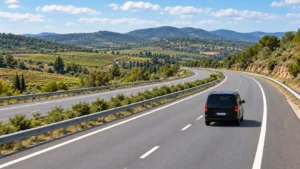
The road route is simple and stays on motorways almost the whole way. It splits into three clear sections.
Barcelona to the French border on the AP-7
From Barcelona, the AP-7 runs north through the Vallès and the Maresme hinterland, past Girona and Figueres, to the border at La Jonquera. This is the main road corridor between Spain and France on the Mediterranean side, so it carries heavy truck traffic on weekdays.
The AP-7 crosses the Pyrenees at a low point. On the Spanish side the town is La Jonquera, known for its large roadside shopping centers. On the French side, the village of Le Perthus sits right on the border. The motorway bypasses both, and the border crossing itself is usually a short slowdown rather than a stop, although checks can happen. Carry your passport or national ID card, because border rules are set by the French and Spanish authorities and can change.
The A9 from the border to Narbonne
Once in France, the motorway becomes the A9, called La Languedocienne. It drops out of the hills onto the Roussillon plain, passes Perpignan, then runs along the edge of the coastal lagoons toward Narbonne.
This stretch is flat and fast. To the east you see the lagoons and the coast; to the west, the Corbières hills begin to rise. If you plan a stop in Collioure, you leave the A9 near Perpignan and head south along the coast.
The A61 from Narbonne to Carcassonne
Just west of Narbonne, at the motorway junction, the route turns onto the A61, sometimes called the Autoroute des Deux Mers because it continues to Toulouse and toward the Atlantic. From here it is about an hour of driving through vineyard country in the Aude valley, past Lézignan-Corbières, to the Carcassonne exits.
As you approach, the walls and towers of the Cité appear on a hill to the south of the motorway. Seen from the road, it is one of the most recognizable skylines in France.
For a wider look at the roads into France from Barcelona, including Perpignan and the coast, see the guide on driving from Barcelona to France, Perpignan, Collioure and beyond.
Barcelona to Carcassonne by train
There is no direct train from Barcelona to Carcassonne. The standard route needs one change, and the official sources to check are SNCF Connect for the French part and Renfe for the cross-border high-speed service.
The usual train route
The most common pattern looks like this:
- Barcelona Sants to Narbonne by high-speed train. Cross-border high-speed services run from Barcelona through Girona, Figueres and Perpignan into France. Both SNCF and Renfe operate trains on this line, and the Barcelona to Narbonne leg takes around two hours, according to timetables published by SNCF and Renfe.
- Narbonne to Carcassonne by regional train. A regional TER train covers the short leg west to Carcassonne in roughly half an hour, according to SNCF.
Including the connection at Narbonne, the full journey is around three and a half hours, according to SNCF and Renfe timetables. Some itineraries change at Perpignan instead, which usually takes longer overall.
What to know before you book the train
The number of daily high-speed trains between Barcelona and France is limited, so the connection at Narbonne shapes your whole day. If the first leg is delayed, you may wait for the next regional train. Check the latest timetables on SNCF Connect and Renfe before you commit to a plan, because schedules change by season.
Barcelona Sants has security screening for high-speed trains, so arrive with some time to spare. On arrival, Carcassonne station is in the lower town, the Bastide Saint-Louis, near the Canal du Midi. The Cité is on the other side of the river Aude, up a hill, so you still need to walk or take local transport to reach the walls.
Fares vary with demand and how early you book. For current fares, check SNCF Connect and Renfe directly.
Car or train: how the two options compare
The table below compares a private car with a driver and the train on practical factors. Distances and times are approximate and come from the sources named.
| Factor | Private car with a driver | Train |
|---|---|---|
| Route | AP-7 to La Jonquera and Le Perthus, then A9 and A61 | High-speed train to Narbonne, then a regional train |
| Approximate distance | About 300 km by road (DGT and Vinci Autoroutes for road information) | Shorter line, but the change at Narbonne adds time (SNCF) |
| Approximate journey time | About 3 hours of driving, before stops (approximate; live traffic from DGT and Vinci Autoroutes) | Around 3.5 hours including the change (SNCF and Renfe) |
| Changes | None, door to door | One change, usually at Narbonne (SNCF) |
| Start and finish | Your hotel, home or address in Barcelona to your address in Carcassonne | Barcelona Sants to Carcassonne station in the lower town |
| Stops on the way | Can be planned, for example Collioure or Narbonne | Only at stations on the line |
| Departure time | Agreed when you request the quote | Fixed by the timetable (SNCF and Renfe) |
| Bags | Loaded once at the door | Carried through two trains and two stations |
| Reaching the Cité | Drop-off near the walls can be planned | Walk or local transport from the station |
| Price | Quoted on request | Fares on SNCF Connect and Renfe |
The train suits a solo traveler with light bags who is happy to follow a fixed timetable. A private car fits better for families, groups traveling together, people with several suitcases, or anyone who wants to stop along the way. For door-to-door details, see the Barcelona to Carcassonne transfer page.
What to see in Carcassonne
Carcassonne is really two towns: the medieval Cité on the hill and the Bastide Saint-Louis, the lower town laid out in a grid on the other bank of the Aude. Most visitors come for the first, but the second is worth an hour too.
The medieval Cité
The Cité de Carcassonne is a fortified hilltop town with two rings of walls and dozens of towers. It was listed by UNESCO as the Historic Fortified City of Carcassonne in 1997. The site has been fortified since Roman times, and the walls you see today grew over the medieval period, when the town became a key stronghold on the frontier between France and Aragon.
By the 19th century the fortress had fallen into disrepair. The architect Eugène Viollet-le-Duc led a long restoration, which is why the walls look so complete today. Some of his choices, such as the pointed slate roofs on the towers, are still debated by historians, but they give the Cité its famous outline.
Inside the walls, the main sights are:
- The Château Comtal, the castle of the counts, with access to a section of the ramparts. It is managed by the Centre des monuments nationaux, which publishes opening hours and ticket details.
- The Basilica of Saint-Nazaire, known for its Gothic choir and stained glass.
- The lists, the open ground between the two rings of walls, where you can walk around a large part of the fortifications.
- The narrow streets of the inner town, with shops, cafés and restaurants.
The Cité is busy in summer and around holidays. Arriving in the morning, or staying until the day visitors leave in the evening, makes a big difference to how it feels.
The Bastide Saint-Louis and the Pont Vieux
The lower town was founded in the 13th century on a grid plan. Its central square, Place Carnot, hosts a market on certain days, and the streets around it are quieter and more residential than the Cité.
The Pont Vieux, the old bridge over the Aude, links the lower town and the Cité. Walking across it gives one of the best views of the walls, especially in the late afternoon light.
The Canal du Midi
The Canal du Midi passes right by Carcassonne station, on the edge of the lower town. Built in the 17th century under the direction of Pierre-Paul Riquet, it links Toulouse to the Mediterranean through a chain of locks, bridges and aqueducts. UNESCO listed it as a World Heritage Site in 1996.
In Carcassonne you can walk or cycle along the towpath, watch boats pass through the lock near the station, or take a short boat trip in season. If you have time, the stretches of canal lined with plane trees outside town are among the most photographed parts of the route.
Day trip or one-way transfer?
The right format depends on how much time you want in Carcassonne and where you are going next.
Carcassonne as a day trip from Barcelona
A Barcelona to Carcassonne day trip is possible, but it is a long day. With about three hours of driving each way, you spend around six hours on the road before any stop. That leaves a realistic window of four to five hours in Carcassonne on a full day out.
A day trip works best if you:
- Start early, so you arrive at the Cité before the midday crowds.
- Focus on the Cité, the Château Comtal and a walk on the ramparts, rather than trying to see everything.
- Keep stops on the way to a minimum, or choose one stop only.
- Accept a late return to Barcelona.
When you request a quote for a day trip, describe the timetable you have in mind: departure time, how long you want in Carcassonne, any stops and the time you want to be back in Barcelona. The schedule is agreed in advance as part of the quote.
A one-way transfer to Carcassonne
A one-way transfer suits travelers who plan to stay in Carcassonne for a night or more, or who are continuing a trip through the south of France. Many people spend a night in or near the Cité, which lets you see the walls lit up at night and walk the streets when they are quiet.
From Carcassonne, Toulouse is about an hour further west on the A61, and the Canal du Midi villages are close by. If your trip continues further, the guide on Barcelona to Toulouse by private driver or train covers that corridor.
A one-way transfer from Carcassonne back to Barcelona, or to Barcelona Airport, can also be arranged at the end of your stay. Give the flight number or departure time in your request, so the journey can be planned around it.
A multi-stop journey into France
Some travelers combine Carcassonne with other places in the south of France in a single journey. The Barcelona to France private transfer page lists the main destinations across the border. Each route is quoted on request.
Stops between Barcelona and Carcassonne
The route passes several places worth a stop. Pick one or two at most if you are doing the trip in a single day.
Collioure
Collioure is a small harbor town on the Côte Vermeille, south of Perpignan, close to the Spanish border. It has a royal castle on the waterfront, a church whose round bell tower stands by the sea, and a tradition of anchovy curing. In the early 20th century, painters such as Henri Matisse and André Derain worked here, and the town is closely linked to the Fauvist movement.
A stop in Collioure means leaving the A9 near Perpignan and driving along the coast, which adds time. It fits better on a one-way transfer, or on a trip with a night in Carcassonne, than on a same-day return. If you want to spend more time on that coast, the Barcelona to Perpignan transfer page covers the area.
Narbonne
Narbonne is right on the route, where the A9 meets the A61, so a stop costs little extra time. It was one of the first Roman colonies in Gaul, and a section of the Via Domitia, the Roman road that linked Italy and Spain, is visible in the city center. The Gothic Cathedral of Saint-Just-et-Saint-Pasteur, with its very tall choir, and the covered market, Les Halles, are both within a short walk of each other.
Narbonne works well as a lunch stop on the way to or from Carcassonne.
If France is too far for one day
If a round trip to Carcassonne feels like too much driving, a private tour closer to Barcelona may suit you better. Two of the private tours offered by Chauffeur Hire Barcelona follow the same northern route as far as Girona and Figueres. Prices are taken from the current price list and are per group, with hotel pickup and drop-off in Barcelona.
| Private tour | Duration | Price |
|---|---|---|
| Medieval Girona and Dali Museum in Figueres | 10h | From €825 per group |
| Medieval Girona and Costa Brava | 10h | From €850 per group |
Both tours stay in Catalonia, so there is no border crossing, and the medieval old town of Girona gives some of the same atmosphere as Carcassonne on a smaller scale.
Practical planning tips for Barcelona to Carcassonne
- Choose your season. Summer brings long daylight hours but also crowds in the Cité and heavy traffic on the A9. Spring and autumn are calmer and usually more comfortable for walking the ramparts.
- Check opening hours in advance. The Château Comtal and the ramparts follow the schedule published by the Centre des monuments nationaux, and hours change through the year.
- Bring identification. You cross an international border. Carry a passport or national ID card valid for travel to France.
- Wear good shoes. The Cité has cobbled streets and uneven paths around the walls.
- Plan meals. Cassoulet, the slow-cooked bean and meat dish of the region, is the local specialty. Restaurants in the Cité fill up at lunchtime in high season.
How to request a quote for Barcelona to Carcassonne
Every journey is quoted on request. To get an accurate quote, send:
- The route: your pickup address in Barcelona or the airport, and your destination in Carcassonne.
- Whether it is a one-way transfer, a return trip or a day trip.
- The date and the time you want to leave.
- Any flight or train you need to meet or catch.
- The number of guests and bags.
- Any stops you want on the way, such as Collioure or Narbonne.
The more detail you give, the easier it is to plan the timing of the day.
Conclusion
Barcelona to Carcassonne is about three hours by road and around three and a half hours by train with a change at Narbonne. The train works for light travelers on a fixed schedule; a private driver suits families, groups, heavy bags and anyone who wants stops at Collioure or Narbonne. To get a quote, send your route, date, time and the number of guests and bags through the contact page, WhatsApp or call +34 632 93 79 41, or email [email protected].
Questions travelers ask
How far is Carcassonne from Barcelona?
Carcassonne is roughly 300 km from central Barcelona by road, about three hours of motorway driving without stops; the DGT and Vinci Autoroutes publish live traffic for the route. The route uses the AP-7 to the French border, then the A9 past Perpignan and the A61 west from Narbonne. Traffic at the border or in summer can make it longer.
Is there a direct train from Barcelona to Carcassonne?
No. According to SNCF and Renfe, rail journeys need at least one change, usually at Narbonne. A high-speed train runs from Barcelona Sants to Narbonne in about two hours, then a regional train reaches Carcassonne in roughly half an hour. Check SNCF Connect and Renfe for current timetables before planning the day.
Can Carcassonne be done as a day trip from Barcelona?
Yes, but it is a long day. Around six hours of driving in total leaves about four to five hours in Carcassonne on a full day out. An early start, a focus on the Cité and the ramparts, and one stop at most make it workable. Many travelers prefer to stay a night instead.
Which route does a private driver take to Carcassonne?
The usual road route follows the AP-7 north past Girona and Figueres to La Jonquera and Le Perthus, where it crosses into France. It continues on the A9, called La Languedocienne, past Perpignan to Narbonne, then turns west on the A61 through the Aude vineyards to the Carcassonne exits below the walled Cité.
What are good stops between Barcelona and Carcassonne?
Narbonne sits right where the A9 meets the A61, so it makes an easy lunch stop with its Roman road remains, Gothic cathedral and covered market. Collioure, a harbor town on the Côte Vermeille linked to Matisse and Derain, needs a detour along the coast and fits better on a one-way transfer than a same-day return.
How much does a private transfer from Barcelona to Carcassonne cost?
Every chauffeur journey from Barcelona is quoted on request rather than from a fixed list. To get a quote, send the route, whether it is one way, a return or a day trip, the date and departure time, any flight or train, the number of guests and bags, and any stops you want on the way.
What is there to see in Carcassonne?
The main sight is the Cité, a hilltop fortified town listed by UNESCO in 1997, with the Château Comtal, the ramparts and the Basilica of Saint-Nazaire. Across the Aude, the lower town has the Bastide Saint-Louis grid, the Pont Vieux with views of the walls, and the Canal du Midi, a UNESCO site since 1996.
Chauffeur Hire Barcelona
Your own car and driver, quoted on request
Airport, cruise port and station transfers, a driver by the hour, day trips and long-distance journeys from Barcelona, plus 12 private tours priced per group.