On this page
Going from Barcelona to France by car means heading north on the AP-7 motorway past Girona and Figueres to the La Jonquera and Le Perthus border, where the road continues as the French A9 toward Perpignan. With a private chauffeur you can treat it as a one-way transfer, a return day trip or a multi-stop journey, quoted on request.
Key takeaways
- The main road route runs up the AP-7 through the Girona area and the Empordà plain, crosses the Pyrenees foothills at La Jonquera and Le Perthus, and becomes the A9 on the French side.
- Spain and France are both in the Schengen area, so the border is normally open, but every traveler should still carry a valid passport or national ID card.
- Perpignan is the first French city after the border, Collioure sits on the coast to the southeast of it, and Carcassonne lies further north and west, inland from Narbonne.
- Girona and Figueres, home of the Dalí Theatre-Museum, are natural stops on the Spanish side of the drive.
- Every chauffeur journey is quoted on request. To get a quote, send the route, the date and time, any flight or train, and the number of guests and bags.
- If you want Girona and Figueres as a private day out rather than a stop on the way to France, the private Medieval Girona and Dali Museum in Figueres tour costs from EUR 825 per group for up to 10 guests and runs for 10 hours.
Which route does the drive from Barcelona to France take?
Most drivers leave Barcelona on the AP-7, the main motorway along the Mediterranean side of Catalonia. It takes you north through the Vallès and the Maresme hinterland, past the turnings for the Costa Brava, and on toward Girona. After Girona the land opens into the Empordà plain, with the Pyrenees foothills on the horizon and the Bay of Roses away to the east.
Figueres is the last large town before the border. Beyond it the motorway climbs gently through rolling, wooded country to La Jonquera, the Spanish border town. On the other side lies Le Perthus, a French village that has grown up on both sides of the frontier line. From there the road continues as the A9 in France, dropping down past Le Boulou toward the Roussillon plain and Perpignan.
The French A9 then runs on north toward Narbonne, where the A61 branches west toward Carcassonne and Toulouse. If you are heading for the coast instead, a smaller road leads from the Perpignan area to Argelès-sur-Mer, Collioure and the rest of the Côte Vermeille.
Is there a coastal alternative?
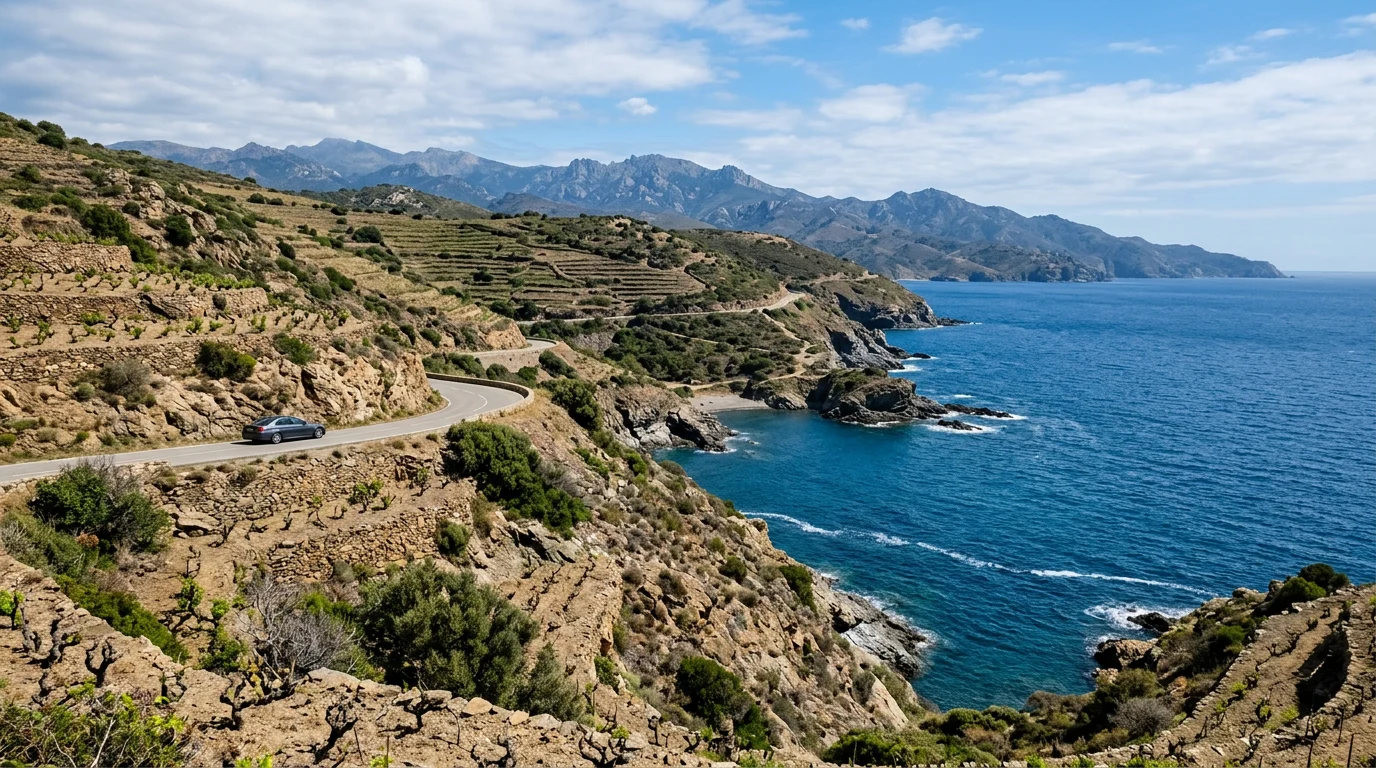
Yes. A slower road leaves the Empordà near Figueres and winds east and north through Llançà and Portbou, crossing into France above Cerbère and continuing along the cliffs to Banyuls-sur-Mer, Port-Vendres and Collioure. It is a beautiful drive with sea views on almost every bend, but it is narrow and twisting, so it suits travelers who want the scenery more than speed. Your driver can tell you which route makes more sense for your date, the season and the people in the car.
How long does the drive take?
Drive times depend heavily on traffic, the time of day and how many stops you make. Leaving central Barcelona at rush hour can add a long time before you even reach the open motorway, and summer weekends and holiday periods bring heavy traffic at the border and on the A9. For an accurate figure on your day, check a live route planner or the information published by the motorway operators on each side of the border. When you ask for a quote, the planned pickup time is part of what shapes the itinerary.
Do you need a passport to cross from Spain into France by road?
Spain and France are both members of the Schengen area, which the European Commission describes as a zone where internal border checks have been lifted for people crossing between member countries. In practice, most cars drive across at La Jonquera and Le Perthus without stopping.
That does not mean documents are optional. Police in both countries can still carry out checks near the border, and Schengen rules allow member states to reintroduce temporary internal border controls in some circumstances. Every traveler, including children, should carry a valid passport or national identity card that is accepted for travel in the EU.
If you hold a passport from outside the EU, check the entry conditions for your nationality with the official government sources of Spain and France before you travel, especially if your visit to France is part of a longer stay in the Schengen area. This guide cannot give legal advice on visas, so treat official government information as the final word.
A few practical points:
- Keep passports or ID cards in a bag inside the car, not in the luggage compartment.
- If you are traveling with children who are not your own, check what supporting documents the authorities of both countries recommend.
- If you are flying home from France after a one-way transfer, make sure your documents also meet the airline's requirements.
Where can you stop on the way to France?
One of the advantages of crossing into France by private car rather than by train is that the road passes several places worth seeing. You can build one or two of them into a one-way transfer or a return day trip.
Girona
Girona is the first major city on the route. Its old town sits above the River Onyar, with brightly painted houses lining the water, the stepped approach to the cathedral, the medieval Jewish quarter known as the Call, and walkable sections of the old city walls. A stop of an hour or two is enough for a short walk and a coffee, while a longer visit allows a proper look at the cathedral and the narrow lanes around it.
Figueres and the Dalí Theatre-Museum
Figueres is the hometown of Salvador Dalí, and the Dalí Theatre-Museum, which the artist designed himself, is the town's best-known sight. It is a short detour off the AP-7 and close to the border, so it fits neatly into a journey to France. Check the museum's official website for opening hours and ticketing before you plan your stop, and allow time for queues in busy months.
Collioure
Collioure is a small harbour town on the Côte Vermeille, where the Pyrenees meet the Mediterranean. Its waterfront is framed by the Château Royal on one side and the church of Notre-Dame-des-Anges, with its bell tower standing at the edge of the sea, on the other. The town is known for its connection with painters such as Henri Matisse and André Derain, who worked here in the early twentieth century, and for its anchovies.
Collioure is compact and gets very busy in summer, and its narrow streets are awkward for anyone driving themselves. Being dropped off near the old town is one of the clear practical benefits of a private transfer from Barcelona to Collioure.
Perpignan
Perpignan is the capital of the Pyrénées-Orientales department and the first sizeable French city after the border. It has a strong Catalan identity: you will see Catalan flags and hear the language. Key sights include the Palace of the Kings of Majorca, the Castillet gateway and the Cathedral of Saint-Jean-Baptiste. Perpignan works as a destination in its own right, as a base for exploring the Roussillon, or as a handover point if you are continuing by train or plane. A Barcelona to Perpignan transfer takes you straight to a hotel, an address or the station.
Carcassonne
Carcassonne's medieval walled city, La Cité, is one of the most recognizable fortified towns in Europe, with a double ring of walls and many towers on a hill above the River Aude. It is listed by UNESCO as a World Heritage Site. Carcassonne is further than Perpignan, reached by continuing north on the A9 and then west on the A61, so it suits travelers who are staying in the region or continuing on into France. For a journey that ends there, see the page on a private transfer from Barcelona to Carcassonne.
Other places in the south of France
Beyond these, travelers also ask about Narbonne, Béziers, Montpellier, Nîmes and the Camargue, and further afield about Provence and the Riviera. These longer journeys are quoted on request in the same way. The page on private transfers from Barcelona to France covers the wider range of French destinations.
One-way transfer, return day trip or multi-stop journey?
A private chauffeur from Barcelona to France can be arranged in three broad ways. The right choice depends on whether you are moving on, coming back the same day, or touring.
One-way transfer
A one-way transfer suits travelers who are continuing their trip in France: moving from a Barcelona hotel to a hotel in Perpignan, Collioure or Carcassonne, catching a flight from a French airport, or joining a rail connection further north. You are collected at your door in Barcelona, or at the airport, the cruise port or Sants station, and taken directly to your address in France. You can add a stop on the way, such as lunch in Girona or a visit to Figueres.
Return day trip
A return day trip uses one car and driver for the whole day, starting and ending in Barcelona. The most common versions focus on the nearest French places: Collioure and the Côte Vermeille, or Perpignan, often combined with a stop in Figueres or Girona on the way back. Carcassonne as a same-day return is possible but makes for a very long day in the car, so many travelers prefer to stay overnight there or take it as part of a one-way journey.
Multi-stop journey
A multi-stop journey links several places in one route, for example Barcelona to Girona, then Figueres, then Collioure, ending in Perpignan. It can also run over more than one day, with overnight stays on the way. Because every journey is quoted on request, the route can be built around your interests and pace.
Comparison at a glance
| Option | What it suits | Price basis |
|---|---|---|
| One-way transfer to France | Moving on to Perpignan, Collioure, Carcassonne or further | Quoted on request |
| Return day trip to France | A day in Collioure or Perpignan, back in Barcelona at night | Quoted on request |
| Multi-stop journey | Girona, Figueres and a French destination in one route | Quoted on request |
| Private tour: Medieval Girona and Dali Museum in Figueres | A private day in Girona and Figueres without crossing the border | From EUR 825 per group, up to 10 guests, 10h, hotel pickup and drop-off in Barcelona |
| Private tour: Medieval Girona and Costa Brava | A private day in Girona and on the Catalan coast | From EUR 850 per group, up to 10 guests, 10h, hotel pickup and drop-off in Barcelona |
Chauffeur transfers are always quoted on request because the price depends on the route, the date and time, the number of guests and bags, and any stops. The two private tours have fixed per-group prices, which include hotel pickup and drop-off in Barcelona.
How does a private car compare with the high-speed train?
The main public alternative is the high-speed rail line that runs from Barcelona through Girona and Figueres-Vilafant and on to Perpignan, with services operated by Renfe and SNCF. For timetables and fares, check those operators directly.
In plain terms, the comparison looks like this:
- Door to door versus station to station. The train runs between stations. Figueres-Vilafant is outside the center of Figueres, and Perpignan station is a transfer away from many hotels. A private car starts at your door and ends at your address.
- Places off the line. Collioure, the Côte Vermeille and Carcassonne's Cité are not on the high-speed line. Reaching them by rail usually means changing trains or adding a taxi. A private car goes straight there.
- Luggage and groups. With a train, everyone handles their own bags through stations. With a private car, luggage goes in at your door and comes out at your destination. For families and groups, a single quote for the whole party can be simpler than buying several tickets.
- Stops on the way. The train does not stop for an hour in Girona or a visit to the Dalí Theatre-Museum. A private car can.
- Speed between city centers. For one or two travelers going from central Barcelona to central Perpignan with little luggage, the train can be a quick and efficient choice, especially when the roads are busy. It is worth comparing both options honestly for your trip.
Planning tips for crossing into France by car
Choose the right departure time
Leaving early avoids the worst of Barcelona's morning traffic and gives you more time at your destination. On summer weekends and during holiday periods, the border area and the A9 can be very busy, so building in extra time is wise. If you have a train or flight to catch in France, tell us when you ask for a quote so the timing can be planned around it.
Think about luggage
Tell us how many bags you are bringing, including large suitcases, golf bags, bikes or strollers. This is part of what decides the right car for your group, so it needs to be in your quote request rather than mentioned on the day.
Plan your stops realistically
Each stop adds time. Girona and Figueres are both close to the route, but a museum visit or a long lunch can take a good part of the day. For a return day trip, it often works best to choose one main French destination and one stop in Catalonia rather than trying to fit in everything.
Check opening times and seasons
Museums, castles and restaurants in both Spain and France have their own opening days and seasonal hours. Check the official website of each place before you travel, especially for Mondays, public holidays and the quieter months.
Carry documents and a payment card
Keep passports or ID cards handy for the border, and carry a payment card for museum tickets, meals and shopping in France. Both countries use the euro, so there is no currency change.
Mention special requirements early
If anyone in your group has reduced mobility, or you are traveling with small children, mention it in your request so the journey can be planned with that in mind.
What to send for a quote
Every chauffeur journey is quoted on request. To get an accurate quote quickly, send:
- The route: where you want to be collected in Barcelona and where you are going in France, plus any stops on the way.
- The date and time: your preferred pickup time and, for a return day trip, roughly when you want to be back.
- Flights or trains: any flight number or train you need to connect with on either side of the journey.
- Guests and bags: the number of people, including children, and the number and size of bags.
With that information, the journey can be planned and quoted for your exact day.
A related option: the Girona and Dalí private tour
Not everyone who looks up the drive north actually wants to cross the border. If your main interest is Girona's old town and the Dalí Theatre-Museum, a private day on the Spanish side may suit you better than a trip into France.
The Medieval Girona and Dali Museum in Figueres private tour runs for 10 hours and costs from EUR 825 per group for up to 10 guests, with hotel pickup and drop-off in Barcelona. Because the price is per group rather than per person, it can work well for families and small groups who want their own car for the day.
If you want both, ask about a custom multi-stop journey that adds Girona or Figueres to a route into France.
Conclusion
Driving from Barcelona to France is straightforward in principle: up the AP-7 past Girona and Figueres, across the open Schengen border at La Jonquera and Le Perthus, and on to the A9 toward Perpignan, Collioure or Carcassonne. The real choices are how you want to travel, which stops you want, and whether you are moving on or coming back the same day.
To plan your journey, send your route, date and time, any flights or trains, and the number of guests and bags. WhatsApp or call +34 632 93 79 41, email [email protected], or use the contact page to ask for a quote.
Questions travelers ask
Which road do you take from Barcelona to France?
The usual route is the AP-7 motorway heading north from Barcelona, past Girona and Figueres, to the border at La Jonquera on the Spanish side and Le Perthus on the French side. After the border the same corridor continues as the A9, which leads to Perpignan and then on toward Narbonne, where the A61 turns west for Carcassonne.
Is there a passport check at the La Jonquera border crossing?
Spain and France are both in the Schengen area, so cars normally cross without stopping. Police on either side can still check documents, and temporary controls are possible. Each traveler, children included, should carry a valid passport or national ID card, and non-EU visitors should confirm entry rules with official Spanish and French government sources.
Can Collioure be done as a day trip from Barcelona?
Yes. Collioure and the Côte Vermeille are among the nearest French destinations, so a return day trip with one car and driver is a common plan. Many travelers pair the harbour town with a stop in Figueres or Girona on the way home. Ask for a quote with your pickup address, date, preferred times and number of guests.
How much does a chauffeur from Barcelona to Perpignan cost?
Chauffeur transfers to Perpignan and other French destinations are quoted on request, because the price depends on the route, the date and time, the number of guests and bags, and any stops. Send those details by WhatsApp or phone on +34 632 93 79 41 or by email to [email protected] to receive a quote.
Is a private car better than the high-speed train to France?
It depends on the trip. The high-speed line run by Renfe and SNCF links Barcelona, Figueres-Vilafant and Perpignan station to station. A private car goes from your door to your address, carries your bags throughout, reaches places off the line such as Collioure or Carcassonne, and can stop in Girona or Figueres on the way.
What is the Medieval Girona and Dali Museum in Figueres private tour?
It is a private day out in Girona and Figueres that stays on the Spanish side of the border. The tour lasts 10 hours and costs from EUR 825 per group for up to 10 guests, with hotel pickup and drop-off in Barcelona. It suits travelers who want Girona and the Dalí Theatre-Museum without continuing into France.
What information do you need to quote a journey to France?
A quote needs four things: the route, meaning your pickup point in Barcelona, your French destination and any stops; the date and time; any flight or train you need to connect with; and the number of guests and bags. With those details the journey can be planned and priced for your exact day.
Chauffeur Hire Barcelona
Your own car and driver, quoted on request
Airport, cruise port and station transfers, a driver by the hour, day trips and long-distance journeys from Barcelona, plus 12 private tours priced per group.