On this page
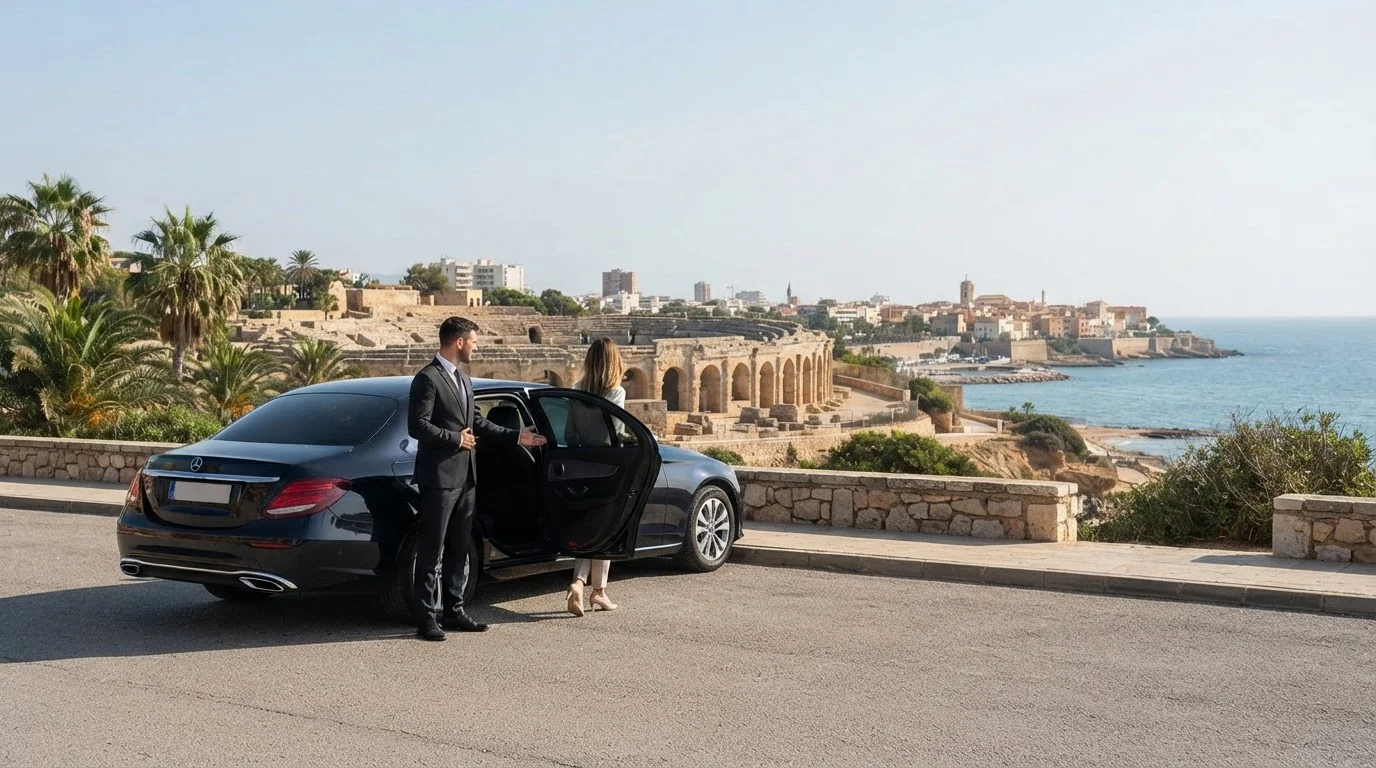
Organizing a self-directed trip across Tarragona's Roman sites by car: a half-day or full-day plan requires coordinating ancient ruins scattered across both the city center and the surrounding countryside. At Chauffeur Hire Barcelona, our private tour covering Roman Tarragona and Mediterranean Sitges spans 10 hours for up to 10 guests from 865 EUR, connecting major UNESCO World Heritage monuments without the hassle of regional transfers.
Key takeaways
- Visiting both the city ruins and the outlying aqueduct requires personal transport or scheduled road transfers.
- A half-day trip covers central monuments like the Amphitheatre and Circus, while a full-day plan incorporates coastal stops and rural Roman monuments.
- Driving allows direct staging at locations like Les Ferreres Aqueduct without relying on municipal bus schedules.
- Fixed-rate chauffeur tours offer Barcelona hotel pickup and drop-off for groups of up to 10 passengers.
Quick answer
A smooth visit to Tarragona by car balances the dense, pedestrian-only historic core with roadside ancient monuments situated outside town. Using road transit lets you bridge distant landmarks like the Les Ferreres Aqueduct and coastal structures before parking to explore the city center on foot.
How the road itinerary works
Driving south from Barcelona along the C-32 or AP-7 highway brings you to the ancient Roman capital of Tarraco in roughly one hour. The road allows you to stop at roadside monuments north of the city before entering the urban grid. Once inside Tarragona, vehicles navigate to perimeter parking facilities, allowing you to walk between the Circus, Praetorium, and seaside Amphitheatre without backtracking.
Transit times and route planning
The drive covers approximately 100 kilometers each way depending on your departure point in Barcelona. Outlying monuments such as the Pont del Diable sit right off the AP-7 and N-240 junction, making them ideal first stops before reaching the seaside center. Planning transit around early morning hours helps you clear metropolitan Barcelona traffic and arrive when the archeological grounds open.
What to expect on the ground
The historic center of Tarragona contains cobblestones, inclines, and restricted access zones called pedestrian areas. While a car provides swift highway travel between monuments, walking remains necessary once you enter the upper old town. Staging your vehicle at designated underground lots along the Via Augusta or Rambla Nova provides easy pedestrian entry to the ruins.
| Option | Who it suits | What makes it different |
|---|---|---|
| Half-Day Drive | Time-constrained visitors | Covers city center and aqueduct only |
| Full-Day Drive | History enthusiasts | Adds coastal stops and rural monuments |
| Private Day Tour | Families and private groups | Barcelona door-to-door transit with driver |
Key facts at a glance
Tarraco was the oldest Roman settlement on the Iberian Peninsula, leaving behind an extensive UNESCO World Heritage collection. Accessing these points smoothly requires understanding where monuments sit relative to modern traffic infrastructure.
Outlying ruins requiring vehicle access
Several essential Roman structures sit outside the walkable core of Tarragona. Les Ferreres Aqueduct, also known as Pont del Diable, is located 4 kilometers north of the city center along the N-240 roadway. Further along the coast near the main highway corridor sit the Scipio Tower and the Arc de Berà, which are inaccessible via casual walking from downtown.
Central archeological landmarks
Inside the municipal boundary, the Roman Amphitheatre overlooks the Mediterranean Sea directly beside the railway lines. Walking inland from the water brings you to the Roman Circus and Praetorium tower, which once connected the lower town to the provincial forum. Surrounding the upper quarter are the ancient Roman walls, where the Archaeological Walk runs along preserved stone foundations.
Logistics for travelers from Barcelona
For cruise passengers docking in Barcelona or visitors staying at central hotels, organizing point-to-point road travel avoids the rigid timetables of regional trains. If you are comparing regional transit options, our guide on choosing a chauffeur, taxi, ride-hail or rental car in Barcelona details the operational differences across Catalonia. Moving by private car allows direct hotel pickup and drop-off while keeping all group belongings secured during sightseeing stops.
| Tour Route | Duration | Price (EUR) |
|---|---|---|
| Roman Tarragona and Mediterranean Sitges | 10h | 865 |
| Essential Montserrat: History and Spirituality | 5h | 835 |
| Montserrat and Boutique Wineries | 10h | 855 |
| Medieval Girona and Costa Brava | 10h | 850 |
| Medieval Girona and Dali Museum | 10h | 825 |
| Montserrat, Girona and Costa Brava | 11h | 845 |
| Costa Brava, Tossa de Mar and Boat Ride | 10h | 865 |
| Roman and Greek Costa Brava with Boat Ride | 10h | 875 |
| Montserrat and Barcelona with Sagrada Familia | 10h | 849 |
| Barcelona in One Day | 8h | 879 |
| The Essence of Barcelona | 5h | 549 |
| Barcelona Highlights and Park Güell | 5h | 799 |
Planning tips
Structuring your visit requires dividing the itinerary between modern driving corridors and ancient pedestrian pathways. Coordinating your timeline ensures you do not waste daylight navigating one-way residential streets.
Half-day driving itinerary
A focused half-day plan starts early with a direct drive to Les Ferreres Aqueduct. Spending 45 minutes walking the park trails gives you a complete view of Roman engineering before morning crowds assemble. From there, drive 10 minutes south to central Tarragona, park near the Balcó del Mediterrani, and spend two to three hours walking through the Roman Amphitheatre, the Circus, and the Praetorium vaults.
Full-day combined itinerary
A full-day itinerary broadens the historical scope and pairs cultural history with regional geography. After exploring the central Tarraco ruins and the Roman walls in the morning, travelers can drive north toward coastal towns. For example, our 10-hour private tour links Roman Tarragona with the seaside resort of Sitges, offering an afternoon along the Mediterranean before heading back to Barcelona. If your wider travel plans involve coastal corridors to the south, review our breakdown of traveling from Barcelona to Valencia by car with a driver or by train to assess long-distance driving logistics.
Parking and pedestrian access
Streets inside the Part Alta (the upper historic town) are closed to non-resident vehicles. Drivers must utilize public parking facilities like Parking Saavedra near the Roman walls or Parking Balcó del Mediterrani near the amphitheatre. Staging at these locations avoids fines and leaves you mere steps from the archeological entry points.
Pre-trip checklist
- Confirm opening times for the municipal museums and the Amphitheatre.
- Set GPS navigation directly to designated underground parking garages.
- Pack supportive walking footwear for rough Roman stone masonry and unpaved park paths.
- Download offline road maps for navigation across regional highway interchanges.
- Verify vehicle drop-off access if coordinating private transfers from Barcelona.
When a private car fits better
Public rail connects Barcelona Sants to Tarragona station, but trains drop travelers at the seaside base, requiring a steep uphill trek to reach the ruins. Furthermore, local trains do not provide access to the outlying aqueduct or regional monuments situated along the highway.
Direct hotel departures and drop-offs
Using a dedicated driver eliminates transfers between suburban trains, metro lines, and regional buses. For guests arriving by air or staying in central accommodations, having a driver collect your party at your hotel door streamlines the entire journey. Every journey is quoted on request based on your specific itinerary, timing, and passenger requirements.
Serving groups and cruise visitors
Travelers arriving on cruise ships or moving with family groups frequently encounter logistical hurdles on public transit. Managing luggage, multiple tickets, and varied walking speeds creates friction. A private car provides group unity, keeping everyone together on a predictable schedule without navigating crowded stations.
Combining multiple regional destinations
Public transport operates on hub-and-spoke models centered on Barcelona, making cross-regional trips between places like Tarragona and Sitges tedious on local rails. A chauffeured day trip connects multiple historic and coastal locations on a single route, maximizing sightseeing hours.
Sources
Official information regarding monuments, transport, and regional logistics is drawn from public records provided by local authorities:
Museu d'Història de Tarragona (MHT)
Historical monument classifications, opening schedules, and preservation guidelines for the Amphitheatre, Roman Circus, Praetorium, and the Archaeological Walk are managed by the Tarragona History Museum under the Ajuntament de Tarragona.
Generalitat de Catalunya Department of Territory
Highway routing information, regional road regulations, and public transit connectivity for the AP-7 motorway, C-32 corridor, and N-240 access roads derive from the Generalitat de Catalunya transport network.
Conclusion
For travelers seeking an efficient day trip to Tarragona's ancient landmarks, taking a private vehicle bridges the gap between remote monuments like the Pont del Diable and the pedestrian ruins of the historic town. This approach best suits families, small groups, and cruise passengers who want direct Barcelona pickup and complete flexibility across their touring itinerary.
Chauffeur Hire Barcelona arranges your journeys across Barcelona, Greater Barcelona, Catalonia, Andorra and long-distance journeys from Barcelona. Our services include airport, cruise port and station transfers in Barcelona, a private driver by the journey or the day, a chauffeur by the hour, business and event chauffeur services, group transportation, long-distance journeys from Barcelona, and 12 private tours from Barcelona priced per group. For bookings, Get a quote, call or WhatsApp +34 632 93 79 41, or email [email protected]. We are located in Barcelona, Catalonia, Spain, and serve travelers throughout Barcelona.
Questions travelers ask
Can you visit Tarragona's Roman ruins in half a day from Barcelona?
Yes, a half-day trip allows sufficient time to drive from Barcelona, visit the Pont del Diable aqueduct, and tour the central Roman Amphitheatre and Circus. A full-day itinerary is recommended if you wish to include museums, the Roman walls, and nearby towns like Sitges.
How far is the Pont del Diable aqueduct from central Tarragona?
The Pont del Diable, or Les Ferreres Aqueduct, sits approximately 4 kilometers north of central Tarragona along the N-240 roadway. Visiting by car takes around 10 minutes from the city center, whereas public transit requires regional buses and additional walking.
How much is a private day tour to Roman Tarragona from Barcelona?
Our private tour covering Roman Tarragona and Mediterranean Sitges costs from 865 EUR per group for up to 10 guests. This 10-hour service includes Barcelona hotel pickup and drop-off.
What Roman sites in Tarragona require a car to access easily?
Les Ferreres Aqueduct (Pont del Diable), the Scipio Tower, and the Arc de Berà sit along regional roadways outside the city center and require personal road transport or private transfers to reach comfortably.
What details are needed to request a private chauffeur quote?
To receive a custom quote for a transfer, hourly hire, or long-distance trip, we require your travel route, the date and time, any flight, train, or cruise ship details, and the total number of guests and bags.
Chauffeur Hire Barcelona
Your own car and driver, quoted on request
Airport, cruise port and station transfers, a driver by the hour, day trips and long-distance journeys from Barcelona, plus 12 private tours priced per group.