On this page
A Priorat day trip from Barcelona works best by car with a driver. Priorat is a mountain wine region inland from Reus, with slate terraces, small hilltop villages and cellars spread across winding roads. Public transport barely reaches the villages, and a driver means nobody in your group has to drive after a tasting.
Key takeaways
- Priorat is a small, rugged wine region in the province of Tarragona, known for steep terraced vineyards on dark slate soil and for villages such as Falset, Gratallops, Porrera and Torroja del Priorat.
- The region holds two wine appellations: the DOQ Priorat in the centre and the DO Montsant, which wraps around it.
- The drive is longer than a trip to Penedès, and the last part climbs on narrow, curving mountain roads, so a full day is the realistic plan.
- Siurana, a hilltop village above a reservoir, and the ruined charterhouse of Escaladei below the Montsant cliffs fit easily into the same day.
- Book winery visits directly with each cellar before you go, because many small producers receive visitors only by appointment.
- No packaged private tour from Chauffeur Hire Barcelona goes to Priorat; a Priorat day is a custom journey, quoted on request.
What is Priorat, and why visit it from Barcelona?
Priorat is a comarca, or county, in the interior of the province of Tarragona in southern Catalonia. It sits behind the coastal plain of Reus and Cambrils, where the land rises into a tangle of hills, ravines and terraces under the long cliffs of the Serra de Montsant.
The region takes its name from the prior of the Carthusian charterhouse of Escaladei, the monastery that once controlled much of this land and planted vines on its slopes. The monks are long gone, but the vines stayed, and wine is still what defines the area.
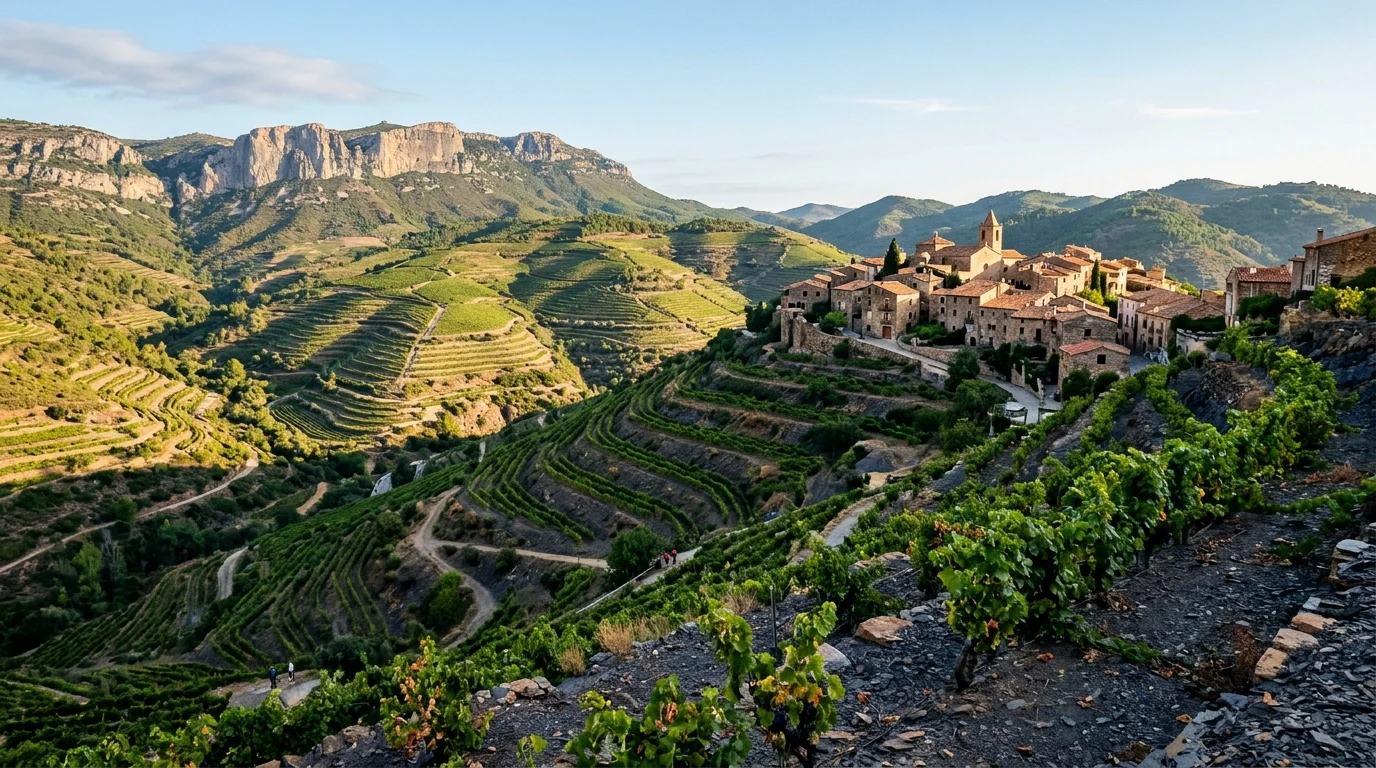
What sets Priorat apart from other wine areas near Barcelona is the landscape. The vineyards are not on gentle plains. They cling to steep slopes and narrow terraces, many of them worked by hand, on a crumbly dark slate the locals call llicorella. The villages are small, quiet and built on ridges or in deep valleys, with stone houses, church towers and views across rows of vines and olive trees.
A Priorat day is slower and more rural than most trips from Barcelona, suited to people who prefer wine, mountain scenery and village walks to museums.
Key facts at a glance
The table below sums up the region. Rules and visitor information come from the official bodies named in the last column.
| Topic | What to know | Official source to check |
|---|---|---|
| Location | Inland county in the province of Tarragona, behind Reus | Turisme del Priorat (Consell Comarcal del Priorat) |
| Wine appellations | DOQ Priorat in the centre, DO Montsant around it | Consell Regulador DOQ Priorat; Consell Regulador DO Montsant |
| Typical soil | Dark slate known as llicorella | Consell Regulador DOQ Priorat |
| Main grapes | Garnatxa (Grenache) and Carinyena (Carignan) | Consell Regulador DOQ Priorat |
| Winery visits | Usually by appointment, booked with each cellar | Each cellar; Turisme del Priorat |
| Escaladei charterhouse | Ruined monastery open to visitors | Agència Catalana del Patrimoni Cultural |
| Serra de Montsant | Protected natural park with cliffs and trails | Generalitat de Catalunya, Parc Natural de la Serra de Montsant |
| Road conditions | Mountain roads in the final stretch | Servei Català de Trànsit |
| Getting there by car | Custom private journey, quoted on request | Chauffeur Hire Barcelona |
DOQ Priorat and DO Montsant: what the labels mean
Two appellations share this corner of Catalonia, and you will see both names on bottles and cellar doors.
DOQ Priorat
The DOQ Priorat covers the heart of the region, around villages such as Gratallops, Porrera, Torroja del Priorat, Poboleda, La Vilella Alta, La Vilella Baixa, Bellmunt del Priorat and El Lloar. DOQ stands for Denominació d'Origen Qualificada, one of the top categories in Spanish wine law. Its regulating council, the Consell Regulador DOQ Priorat, sets the rules for the area and publishes visitor information about its member cellars.
Priorat reds are known for their depth, built mostly on old Garnatxa and Carinyena vines rooted in the slate.
DO Montsant
The DO Montsant forms a ring around the DOQ Priorat, taking in villages such as Falset, Cornudella de Montsant, Capçanes and Marçà. The soils are more varied and the landscape a little more open. Many visitors find Montsant cellars easy to fit into the same day, and Falset, the county town, sits inside this area.
You do not need to choose one appellation. Pick the cellars you want, wherever they fall, and build the route around them.
How do you get to Priorat from Barcelona?
There are three realistic ways to reach Priorat: a car with a driver, a rental car you drive yourself, or a train to the edge of the region followed by a local taxi.
The road route
From Barcelona the road heads south along the coast towards Tarragona and Reus on the motorway. Beyond Reus the road turns inland and climbs over the hills into Priorat, and from there smaller roads branch out to each village and cellar.
The first part of the drive is fast and simple. The second part is not: the routes curve along valleys, cross ridges and pass through villages with tight bends. It is beautiful but slow, and no place to find your way after a tasting.
Treat the trip as a full day out. It is a clearly longer drive than a Penedès day, and the time spent between cellars inside Priorat adds up because the villages are spread out and the roads twist. For live traffic and road conditions on the day, the Servei Català de Trànsit publishes official traffic information for Catalonia.
By train and taxi
A regional rail line runs through the south of the region, with a station between Marçà and Falset. The station sits outside the villages, though, and the cellars are scattered across the hills, so you would still need a taxi or a car to move between them. For current services, the official source is Rodalies de Catalunya. For most visitors this option turns a simple wine day into a puzzle of connections.
By rental car
Driving yourself works only if one person is happy not to taste and is comfortable on narrow mountain roads, then on the long road back to Barcelona.
Planning a winery day in Priorat
A good Priorat day usually has two or three cellar visits, a long lunch and one or two village stops. Trying to fit in more tends to mean more time on the road and less time enjoying the region.
Choose your cellars first
Start by choosing the cellars, then plan the route around them. Priorat has everything from family estates with a handful of terraces to larger, well known producers. Some offer guided visits of the vineyard and cellar, others focus on a seated tasting. The Consell Regulador DOQ Priorat, the Consell Regulador DO Montsant and Turisme del Priorat all publish information about cellars that receive visitors.
Book each visit directly with the cellar before you travel. Many small producers do not keep regular visitor hours and only open by appointment, and visit formats, prices and languages are set by each cellar. Confirm those details with them, not with your driver.
Falset
Falset is the county town and the natural gateway to Priorat for anyone coming from Reus. It has a small old centre, a castle on the hill and one of the region's best known buildings, the modernist wine cooperative designed by the architect Cèsar Martinell, one of the so-called wine cathedrals of Catalonia. Falset also has shops, cafés and restaurants, which makes it a practical stop at the start or the end of the day.
Gratallops
Gratallops is a small hilltop village in the middle of the DOQ Priorat, surrounded by terraced vineyards. It is closely linked with the modern revival of Priorat wine, and several cellars are in or near the village. The views from its edge give a clear idea of how steep the vineyards really are.
Porrera, Torroja and the valley villages
Porrera lies in a valley with stone bridges and narrow streets, ringed by vineyards on the slopes above. Torroja del Priorat sits high on a ridge, while La Vilella Baixa is known for its tall, narrow houses stacked above the river. Each is worth a short walk if your cellars are nearby.
Lunch
Lunch is often the centre of a Priorat day. Village restaurants serve Catalan country cooking, and some cellars arrange food with their visits. Book ahead, especially at weekends.
Siurana, Escaladei and other stops for the same day
Wine is the main reason to come, but some of the best moments in Priorat have nothing to do with tasting.
Siurana
Siurana is a tiny village perched on a rocky outcrop high above the Siurana reservoir, near Cornudella de Montsant. It was the last Moorish stronghold in Catalonia, and local legend tells of a Moorish queen who leapt from the cliff on horseback rather than surrender. Today it is a quiet place of stone lanes, a Romanesque church and wide views over the reservoir and the Montsant range. It is also known among rock climbers for the cliffs around it.
The road up to Siurana is narrow and winding, and parking near the village is limited. Being dropped close to the village entrance and collected afterwards is one of the clearest advantages of having a driver.
The charterhouse of Escaladei
The Cartoixa d'Escaladei lies in a green valley at the foot of the Montsant cliffs. It was the first Carthusian monastery in the Iberian Peninsula, and it is the place that gave Priorat its name. Much of it is in ruins, but the scale of the site and its setting under the cliffs make it a memorable stop. The Agència Catalana del Patrimoni Cultural manages the monument, and it is the official source for visiting arrangements.
The nearby village of Escaladei and the town of La Morera de Montsant, higher up under the cliffs, make good short stops on the same side of the region.
Serra de Montsant
The Serra de Montsant is a long wall of rock along the northern edge of Priorat, protected as a natural park by the Generalitat de Catalunya. A short walk to a viewpoint fits a wine day.
Priorat or Penedès: which wine day suits your group?
Priorat and Penedès are both good wine days from Barcelona, but they are very different trips.
Penedès lies much closer to the city. It is the home of cava, with larger estates, gentler rolling vineyards and towns such as Sant Sadurní d'Anoia and Vilafranca del Penedès. It suits a half day or a relaxed full day, and it works well for first-time wine visitors. If that sounds like your group, read our guide to a Penedès wine day closer to the city.
Priorat is further away, wilder and more intimate. The vineyards are steep, the cellars are often small, and the day leans towards red wine, mountain views and village life. It suits travelers who have already done a classic wine day, who want something more remote, or who already know and like Priorat wines.
A simple way to decide: choose Penedès if you want more time at the cellars and less time on the road; choose Priorat if the landscape and the remoteness are part of what you are looking for.
Combining Priorat with Poblet, Tarragona or Reus
Because Priorat is in the south of Catalonia, it can be part of a longer journey rather than a simple return trip.
Poblet and the Cistercian Route
The Royal Monastery of Santa Maria de Poblet and the walled town of Montblanc lie inland, northeast of Priorat. A long day can take in Poblet in the morning and one or two cellars in the afternoon, but that is a full schedule. Our post on Poblet and the Cistercian Route covers that side of the map in detail.
Tarragona and the coast
Tarragona and its Roman sites are on the way from Barcelona to Priorat. You could stop there on the way back, or spend a night on the coast and visit Priorat the next day, which removes the pressure of a long return drive.
Reus and Reus Airport
Reus is the closest city to Priorat, and Reus Airport is the nearest airport. If you arrive or leave through Reus, a Priorat visit can sit between the airport and Barcelona, or be the first day of a stay on the Costa Daurada. A driver can collect you at the airport and take you on through the hills, with the journey quoted as one route.
A sample Priorat day from Barcelona
This outline shows how a day can fit together. Your own plan will depend on the cellars you book.
- Morning: Pickup in Barcelona and the drive south past Tarragona and Reus, then up into the hills towards Falset.
- Late morning: First cellar visit near Falset or Gratallops, booked in advance with the cellar.
- Lunch: A long lunch in a village restaurant or at a cellar that offers food.
- Afternoon: A second cellar visit, then a stop at Siurana or the charterhouse of Escaladei.
- Evening: The drive back to Barcelona, or on to a hotel on the coast or near Reus.
Planning tips
- Book cellars first. Fix the winery visits before anything else, then share the confirmed times and addresses when you ask for a quote.
- Keep it to two or three cellars. The roads between villages are slow, and rushing defeats the purpose of the trip.
- Book lunch. Village restaurants are small, and weekends fill up.
- Start early. An early departure from Barcelona gives you a relaxed first visit and more daylight on the mountain roads.
- Check the season. Harvest time is lively, but it is also when cellars are busiest; ask each cellar what visits look like on your dates.
- Consider a night away. Staying a night in Priorat or on the coast turns a long day into an easy one.
- Check official sources. Use the Consell Regulador DOQ Priorat, the Consell Regulador DO Montsant and Turisme del Priorat for cellars and visitor information, and the Servei Català de Trànsit for road conditions.
When a private car fits better
A private car with a driver suits Priorat better than most destinations near Barcelona, for a few clear reasons.
- Tasting without driving. Nobody in your group needs to give up the wine to take the wheel.
- Scattered cellars. The cellars and villages are spread across the hills, and there is no practical way to link them without a car.
- Mountain roads. The final stretch is narrow and winding. A driver handles it while you look at the view.
- Your own timing. The day follows your bookings, not a fixed route, so a long lunch or an extra stop is easy.
- Small villages. Being dropped near the entrance of Siurana, a village square or a cellar door avoids the search for parking.
- One journey, any shape. You can return to Barcelona, continue to the coast or end at Reus Airport.
For a full day with several stops, a driver by the day or by the hour works well, and a winery chauffeur from Barcelona can be arranged for any wine region in Catalonia, including Priorat.
Private tours from Barcelona for wine and the south of Catalonia
Chauffeur Hire Barcelona has 12 private tours priced per group, but none of them goes to Priorat. The two closest in spirit are a wine day near Montserrat and a day in Tarragona and Sitges. The prices below are per group, by group size.
| Private tour | Duration | Up to 2 guests | Up to 4 guests | Up to 6 guests | Up to 10 guests |
|---|---|---|---|---|---|
| Montserrat and Boutique Wineries: a Sensor Journey | 10h | €855 per group | €1,085 per group | €1,475 per group | €1,885 per group |
| Roman Tarragona and Mediterranean Sitges | 10h | €865 per group | €1,125 per group | €1,495 per group | €1,899 per group |
The Montserrat and Boutique Wineries private tour pairs the mountain of Montserrat with visits to boutique wineries. It is a ready-made wine day with a fixed price, but it does not visit Priorat. The Roman Tarragona and Mediterranean Sitges private tour covers the Roman city and the seaside town, which is useful if you want the south of Catalonia without the mountain roads.
A day built around Priorat itself is a custom journey and is quoted on request.
What a quote for a Priorat day needs
Every chauffeur journey from Barcelona is quoted on request. To prepare a quote for a Priorat day, send:
- The route: your pickup point in Barcelona, the villages or cellars you plan to visit, and where the day ends.
- The date and the times: your preferred departure time and the times of your cellar bookings and lunch.
- Any flight, train or ship: if the day starts or ends at an airport, station or cruise terminal.
- The number of guests and bags.
You can send these details by WhatsApp or phone on +34 632 93 79 41, or by email to [email protected].
Sources
- Consell Regulador DOQ Priorat: the appellation's rules, grape varieties and member cellars.
- Consell Regulador DO Montsant: the surrounding appellation and its cellars.
- Turisme del Priorat (Consell Comarcal del Priorat): visitor information for the county, its villages and wine tourism.
- Agència Catalana del Patrimoni Cultural: the charterhouse of Escaladei.
- Generalitat de Catalunya: the Parc Natural de la Serra de Montsant.
- Servei Català de Trànsit: official traffic and road information for Catalonia.
- Rodalies de Catalunya: regional rail services in Catalonia.
Plan your Priorat day
Priorat rewards a slow day with a driver: a few booked cellars, a village lunch and a stop at Siurana or Escaladei on the way home. When your cellar visits are set, ask for a quote with your route, date, times and group size, or WhatsApp +34 632 93 79 41.
Questions travelers ask
Is a Priorat day trip from Barcelona worth it?
Yes, if you enjoy red wine, mountain scenery and quiet villages. Priorat is a remote, rural region with steep slate terraces and small cellars, so it feels very different from the city. It is a long day, so it suits travelers who are happy to spend part of it on the road in exchange for a landscape few day trips can match.
How do I get from Barcelona to Priorat without a car?
A regional rail line passes the south of the region, with a station between Marçà and Falset, and Rodalies de Catalunya is the official source for its services. The station is outside the villages, and the cellars are scattered across the hills, so you would still need a taxi between stops. For most visitors, a car with a driver is far simpler.
Do any Chauffeur Hire Barcelona private tours go to Priorat?
No. None of the 12 private tours visits Priorat. The closest options are Montserrat and Boutique Wineries: a Sensor Journey, from €855 per group for up to 2 guests, and Roman Tarragona and Mediterranean Sitges, from €865 per group for up to 2 guests. A Priorat day is arranged as a custom journey and quoted on request.
How many wineries can I visit in one day in Priorat?
Two or three cellar visits is a comfortable number for one day. The villages are spread out and the mountain roads between them are slow, and lunch usually takes a good part of the afternoon. Book each visit directly with the cellar before you travel, since many small producers only receive visitors by appointment.
What is the difference between DOQ Priorat and DO Montsant?
The DOQ Priorat is the central appellation, around villages such as Gratallops, Porrera and Torroja del Priorat, and it holds one of the top categories in Spanish wine law. The DO Montsant surrounds it and includes Falset and Cornudella de Montsant. Each has its own regulating council, which is the official source for its rules and member cellars.
Can I visit Siurana and Escaladei on a Priorat wine day?
Yes, both fit well alongside one or two cellar visits. Siurana is a small hilltop village above a reservoir, reached by a narrow road with little parking, and Escaladei is a ruined charterhouse at the foot of the Montsant cliffs. The Agència Catalana del Patrimoni Cultural is the official source for visiting the charterhouse.
What do I need to send for a Priorat day quote?
Send the route, including your Barcelona pickup point, the cellars or villages you plan to visit and where the day ends, plus the date, the times of your bookings and the number of guests and bags. Add any flight, train or ship if relevant. Contact Chauffeur Hire Barcelona by WhatsApp or phone on +34 632 93 79 41 or at [email protected].
Chauffeur Hire Barcelona
Your own car and driver, quoted on request
Airport, cruise port and station transfers, a driver by the hour, day trips and long-distance journeys from Barcelona, plus 12 private tours priced per group.