On this page
A Vall de Núria day trip from Barcelona works best as a road leg plus a rail leg. A driver takes the C-17 north through Vic and Ripoll to Ribes de Freser or Queralbs, then the Cremallera de Núria rack railway climbs to the valley, because no road reaches Núria. Plan an early start and a full day.
Key takeaways
- Vall de Núria has no road access. You reach it on the Cremallera de Núria rack railway or on foot, according to the Vall de Núria resort.
- The railway boards at Ribes-Enllaç or Ribes-Vila in Ribes de Freser, or higher up at Queralbs, which is the last point you can reach by road.
- The road from Barcelona runs north on the C-17 through Vic and Ripoll. Route planners such as Google Maps usually show roughly two hours to Queralbs in light traffic.
- The rack railway is operated by FGC, the Catalan railway company. Check FGC or the Vall de Núria resort for fares and the published schedule before you set a pickup time.
- At the top you find the sanctuary, a lake, walking trails and, in winter, gentle snow activities. The valley floor sits at close to 2,000 meters, so pack layers in every season.
- Ripoll's monastery and the Ribes valley fit neatly into the drive home.
Where is Vall de Núria and why is it different?
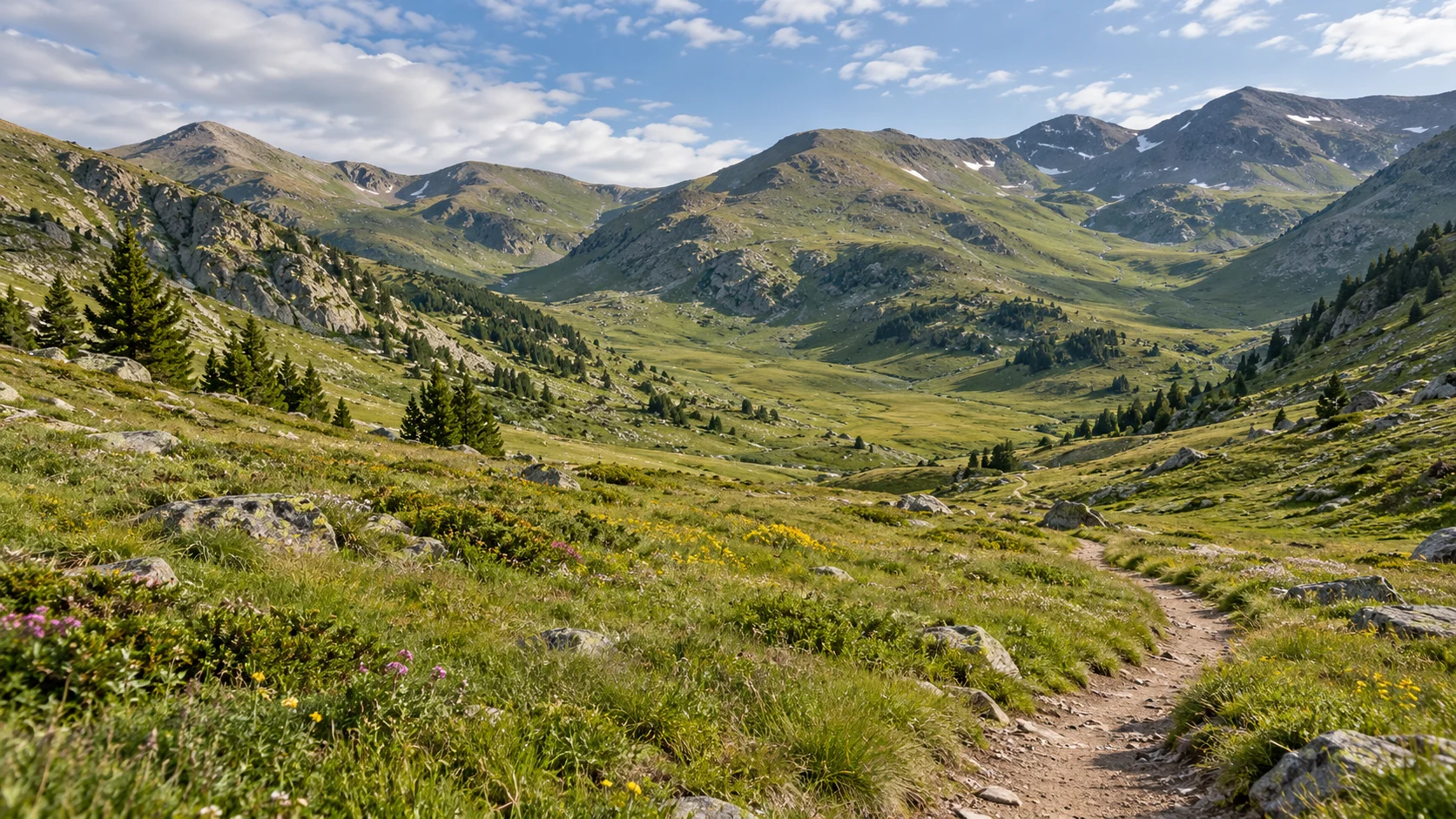
Vall de Núria is a high mountain valley in the eastern Catalan Pyrenees, in the Ripollès area of the province of Girona. It sits inside the municipality of Queralbs, close to the French border, and is ringed by peaks that rise well above 2,500 meters.
What makes it different from most day trips out of Barcelona is access. There is no road into the valley. Visitors arrive on the Cremallera de Núria, a rack railway that has carried people up the Freser and Núria gorges for close to a century, or they walk up an old mule path from Queralbs.
That fact shapes the whole day. A car can take you to the foot of the railway, but not to the sanctuary, so the plan has two halves: the drive north and the train up the mountain.
How do you get to Vall de Núria from Barcelona?
The usual route by road is the C-17, the main road north from Barcelona into the Osona and Ripollès areas. It passes Vic, continues to Ripoll, and then the N-260 follows the Freser river up to Ribes de Freser. From Ribes, a narrow local road climbs to Queralbs.
Route planners such as Google Maps generally show the drive from central Barcelona to Ribes de Freser at somewhere between about one and three quarter hours and two hours, with Queralbs a little further on. Real times depend on where you start in the city, the time of day and the weather in the mountains. A Friday evening or a Sunday afternoon in the ski season can be slower on the C-17.
The regional rail line from Barcelona to Puigcerdà also stops at Ribes-Enllaç, where it connects with the rack railway. A car with a driver suits groups who want their own start time, stops on the way, or room for winter gear.
For a broader view of mountain roads in the region, including the routes toward La Molina and Andorra, the guide to ski resorts near Barcelona by road covers the main corridors and winter driving points.
What is the Cremallera de Núria rack railway?
The Cremallera de Núria is the rack railway that links the Ribes valley with Vall de Núria. A rack railway uses a toothed rail between the running rails, which lets the train grip on gradients that an ordinary train could not handle.
According to FGC, which operates the line through its tourist train brand, the route is about 12.5 kilometers long and climbs roughly 1,000 meters. The top station at Núria sits at about 1,960 meters above sea level. FGC describes the full ride from Ribes-Enllaç as taking around 40 minutes, with a shorter ride from Queralbs.
The line has three main stops below the valley:
- Ribes-Enllaç, next to the regional rail station in Ribes de Freser, where the mainline train connects.
- Ribes-Vila, in the town itself.
- Queralbs, a stone village higher up the valley and the last stop that has road access.
Above Queralbs the line runs through tunnels and along the side of the Núria gorge, the most dramatic part of the ride.
Fares, service frequency and seasonal closures are set by FGC and the Vall de Núria resort. Check the operator for fares and the railway's published schedule before your trip, and confirm again close to the date, because services change between summer, winter and maintenance periods.
Queralbs or Ribes de Freser: where should you board?
Both work. The choice comes down to how much of the ride you want, how long a drive you prefer, and how the day fits around the train.
| Factor | Ribes de Freser (Ribes-Enllaç or Ribes-Vila) | Queralbs |
|---|---|---|
| Road leg from Barcelona | Slightly shorter, mostly on the C-17 and N-260 | A little longer, with a final narrow mountain road from Ribes |
| Rack-railway leg | Full ride, about 40 minutes according to FGC | Shorter ride, only the upper section |
| Scenery on the train | Lower valley plus the full gorge section | Gorge section only, which is the most dramatic part |
| Link with the regional rail line | Direct, at Ribes-Enllaç | None |
| Village to explore | Ribes de Freser, a working valley town | Queralbs, a small stone village with a Romanesque church |
| Best for | Travelers who want the whole railway experience | Travelers who want less time on the train and more time at the top |
| Walking option | Not practical as a walking start for most visitors | Start of the old path up to Núria on foot |
A simple rule of thumb: if the train ride itself is part of the reason you are going, board at Ribes. If your priority is time in the valley, board at Queralbs. Many visitors go up from one and come down to the other, which a driver can handle because the car can reposition while you are at the top.
Can you drive all the way to Vall de Núria?
No. The Vall de Núria resort states that vehicles cannot drive into the valley. The last point you can reach by road is Queralbs, and the approach from Ribes de Freser to Queralbs is a narrow, winding local road.
This is one of the main reasons people book a car with a driver for the day. You do not have to park at the stations or follow a mountain road in poor weather. You step out at the station of your choice, take the train up, and continue by car from the station you agreed in advance.
If your plan is to board at one station and return to another, say so in your quote request. The driver can then plan where to be when you come down.
What is there to do at the top?
The valley floor is compact and easy to explore on foot. Plan on roughly three to five hours at the top, which leaves time for the drive home or an extra stop on the way back.
The Sanctuary of Núria
The Santuari de la Mare de Déu de Núria sits on the valley floor beside the lake. It houses a carved Romanesque figure of the Virgin of Núria, long venerated by shepherds and families from across Catalonia and beyond.
The sanctuary is also known for a local custom. Visitors who hope to have children traditionally put their head into an old cooking pot and ring a bell inside the chapel. Núria has been a place of pilgrimage for centuries.
Opening times for the sanctuary vary by season. Check with the Vall de Núria resort before you go.
The lake and the valley floor
The Estany de Núria, a small lake in front of the sanctuary, is the center of the valley. A flat path loops around it, which makes it the easy walk of the day for families with young children, older travelers and anyone who wants views without effort.
In summer the meadows around the lake are a popular picnic spot. In winter the lake can freeze and the valley floor turns white.
Walks from the valley
Vall de Núria is a starting point for mountain walking in the eastern Pyrenees. A few options, in general terms:
- The lake loop, flat and short, suitable for almost everyone.
- Walks toward the Pic de l'Àliga viewpoint, which can be shortened by taking the small cable car that runs from the valley floor, when it is operating.
- The old path down to Queralbs, the traditional route through the Núria gorge. It is a real mountain walk with uneven ground and a long descent, so proper footwear matters.
- Higher peaks such as Puigmal, at close to 2,910 meters, are serious full-day ascents for experienced and well-equipped hikers only.
Check the route information published by the Vall de Núria resort, and the weather forecast from the Servei Meteorològic de Catalunya, the Catalan weather service, before you commit to anything longer than the lake loop.
Is Vall de Núria worth it?
For most visitors, yes, if the weather is clear and you enjoy mountain scenery. The train ride alone is a highlight, and the valley gives a real high-mountain atmosphere within a day's reach of Barcelona.
It is less suited to travelers who want a busy town with shops and many restaurants, or who dislike cold weather. Núria is quiet, simple and focused on the outdoors. In poor visibility, the main appeal of the views is lost, so keep the date flexible if you can.
What is Vall de Núria like in winter?
In winter Vall de Núria becomes a small, family-oriented snow area. The resort runs a handful of gentle slopes for beginners and children, sledging areas, snow play zones and snowshoe routes, depending on snow cover and conditions.
It is not a large ski resort. Experienced skiers usually prefer bigger areas such as La Molina or Masella in the Cerdanya, or the Andorran resorts. Núria's appeal in winter is the setting, the train ride through a snowy gorge, and a relaxed day in the snow without steep or crowded slopes.
The road leg matters more in winter. The C-17 is a main road, but snow and ice are possible on the higher sections around Ripoll and Ribes, and on the local road up to Queralbs. The Servei Català de Trànsit, the Catalan traffic authority, publishes road conditions and any chain requirements. It is worth checking them on the morning of the trip.
Summer and winter compared
| What to expect | Summer | Winter |
|---|---|---|
| Main activities at the top | Lake loop, hiking, picnics, sanctuary visit | Beginner slopes, sledging, snow play, snowshoeing, sanctuary visit |
| Who it suits best | Walkers, families, photographers | Families with young children, first-time snow visitors |
| Weather pattern | Mild days, cool mornings, afternoon storms possible | Cold, snow on the ground, short daylight |
| Road leg | Usually straightforward on the C-17 and N-260 | Check Servei Català de Trànsit for snow and chain rules |
| What to pack | Layers, rain shell, sun protection, walking shoes | Warm waterproof layers, gloves, hat, sunglasses, spare socks |
| Main planning point | Set off early to beat afternoon storms | Confirm that the railway and snow areas are open that day |
Combining Núria with Ripoll and the Ribes valley
The drive north passes some of the most important historic sites in Catalonia, so it makes sense to build one into the day.
Ripoll and the Monastery of Santa Maria
Ripoll is often called the cradle of Catalonia. Its Monastery of Santa Maria was founded in the 9th century and is associated with Count Wilfred the Hairy, known in Catalan as Guifré el Pelós, a key figure in the early history of the Catalan counties. His tomb is in the monastery church.
The highlight for most visitors is the carved Romanesque portal on the west front, a large stone facade covered in biblical scenes. A visit of an hour or so fits well on the way back down from the mountains, because Ripoll sits directly on the route home. Check the monastery's own information for opening hours and entry.
The Ribes valley and Queralbs
If you board the train at Ribes, take a little time in Queralbs too, either before or after the trip up. The village is small, built from stone, and has a Romanesque church with a porch looking down the valley. It is a calm place for a coffee before the drive home.
Vic on the way
Vic, on the C-17 roughly halfway between Barcelona and Ripoll, has a large arcaded main square and a cathedral worth a short visit. It makes a good breakfast or late lunch stop.
If medieval villages are your main interest, the guide to a Besalú day trip by car with a driver covers a different part of the Girona hinterland. For another inland day with a strong single sight, the Cardona day trip guide explains the salt mountain and castle.
Sample plans for the day
These outlines are a starting point. Adjust them to the railway's published schedule on your date, your group's pace and the season.
Plan one: Núria and Ripoll
- Early morning pickup in Barcelona.
- Drive north on the C-17, with a short coffee stop if needed.
- Board the rack railway at Ribes-Enllaç for the full ride.
- Spend the middle of the day in the valley: the sanctuary, the lake loop and lunch.
- Ride back down to Ribes or Queralbs.
- Stop at the Monastery of Santa Maria in Ripoll on the way home.
- Return to Barcelona in the evening.
Plan two: more time in the valley
- Early pickup and drive straight to Queralbs.
- Board at Queralbs for the shorter ride up.
- Spend most of the day walking around the valley or toward the Pic de l'Àliga viewpoint.
- Come back down by train and drive home, with a stop in Vic if time allows.
Plan three: a winter snow day
- Pickup timed so you reach the railway around its first services of the day.
- Board at Ribes or Queralbs with warm clothes and snow gear.
- Spend the day on the beginner slopes, sledging or snowshoeing.
- Come down before dark, when the roads are easier.
- Drive straight back to Barcelona, or stop in Ripoll for an early dinner.
Weather, altitude and practical advice
The valley floor sits at close to 2,000 meters. That is high enough to feel a real difference from Barcelona, in temperature, sun and weather.
- Dress in layers. It can be warm by the lake at midday in summer and cold an hour later when cloud comes in. In winter, temperatures well below freezing are normal.
- Protect against the sun. UV is stronger at altitude, and snow reflects it. Bring sunglasses, sunscreen and a hat in every season.
- Watch for summer storms. Afternoon thunderstorms are common in the Pyrenees in summer. Start walks early and come down from exposed ground if the sky darkens.
- Wear proper shoes. The lake path is easy, but any trail beyond it is mountain ground.
- Bring water and snacks for any walk.
- Check the forecast. The Servei Meteorològic de Catalunya publishes mountain forecasts for the Pyrenees.
- Check the railway. Confirm opening days, the published schedule and any maintenance closures with FGC or the Vall de Núria resort.
- Allow for the altitude. Most healthy visitors are fine at 2,000 meters, but people with heart or breathing conditions should check with their doctor before a strenuous walk.
Why go by car with a driver?
A driver turns a two-part journey into one simple day. You leave from your hotel or apartment, choose your boarding station, and continue by car from the bottom station to Ripoll, Vic or home, as agreed when you book.
Being driven also means you can enjoy the views on the way up and rest on the way back.
For families and groups, it means one plan and one vehicle for everyone, with room for snow gear, hiking boots and picnic bags. You can learn more about how a day with a driver works on the chauffeur service Barcelona page. If you are comparing mountain days, the guide to Montserrat by private car covers another rack railway trip closer to the city.
Planning your Vall de Núria day trip
A Vall de Núria day trip from Barcelona rewards early planning around the train. Decide where you want to board, check the railway's published schedule with FGC or the Vall de Núria resort, and then set a pickup time that gets you to the station with a comfortable margin.
To get a quote for the day, send the route you have in mind, the date and time, and the number of guests and bags. Every journey is quoted on request. You can WhatsApp or call +34 632 93 79 41 at wa.me/34632937941, email [email protected], or use the quote form on the contact page.
Questions travelers ask
How do you reach Vall de Núria if there is no road?
The valley is reached only by the Cremallera de Núria rack railway or on foot, according to the Vall de Núria resort. Travelers from Barcelona drive or take the regional train north to Ribes de Freser or drive on to Queralbs, then board the rack railway. The last point reachable by road is Queralbs, where the old walking path to Núria also starts.
How long is the drive from Barcelona to the Núria rack railway?
Route planners such as Google Maps usually show roughly one and three quarter hours to two hours from central Barcelona to Ribes de Freser, with Queralbs a little further. The route follows the C-17 through Vic and Ripoll, then the N-260 up the Freser valley. Traffic, weather and your exact starting point in the city all change the real time.
Should I board the Cremallera de Núria at Queralbs or Ribes de Freser?
Board at Ribes de Freser if you want the full ride, which FGC describes as about 40 minutes, and the lower valley scenery. Board at Queralbs for a shorter ride that still covers the gorge, plus more time at the top. Some visitors go up from one station and return to the other, with the car repositioned between them.
Who runs the Núria rack railway and where are fares published?
The rack railway is operated by FGC, the Catalan railway company, and the Vall de Núria resort also publishes visitor information for it. Fares, service frequency and seasonal closures are published by FGC and the resort. Check their published schedule before setting a pickup time in Barcelona, and confirm again close to your date, since services change between seasons and maintenance periods.
What can you do in Vall de Núria in winter?
In winter the resort offers a small set of gentle slopes for beginners and children, sledging and snow play areas, and snowshoe routes, depending on snow cover. It is a family snow day rather than a large ski area. Road conditions on the C-17 and the road to Queralbs should be checked with the Servei Català de Trànsit before leaving.
Is Vall de Núria worth visiting on a day trip?
For travelers who enjoy mountain scenery, it usually is. The rack railway through the gorge, the sanctuary and the lake give a high-mountain day within reach of Barcelona. It is quiet and outdoors-focused, with few shops. Clear weather makes a large difference, so a flexible date helps if the forecast shows low cloud or storms.
Can Ripoll be combined with Vall de Núria in one day?
Yes. Ripoll lies directly on the C-17 route between Barcelona and Ribes de Freser, so a stop at the Monastery of Santa Maria fits naturally on the way back. The monastery is known for its carved Romanesque portal and the tomb of Count Wilfred the Hairy. Allow around an hour and check the monastery's own opening information.
Chauffeur Hire Barcelona
Your own car and driver, quoted on request
Airport, cruise port and station transfers, a driver by the hour, day trips and long-distance journeys from Barcelona, plus 12 private tours priced per group.