On this page
A Besalu day trip from Barcelona works best by car with a private driver, because the Garrotxa is a cluster of small places with no single rail line linking them. In one day you can cross Besalu's medieval bridge, see Castellfollit de la Roca on its basalt cliff, walk around Santa Pau and finish in Olot.
Key takeaways
- Besalu, Castellfollit de la Roca, Santa Pau and Olot sit close together in the Garrotxa, inland from Girona, and suit a single loop by road.
- A private driver turns four or five rural stops into one continuous day, without matching bus connections between villages.
- The usual approach runs north on the AP-7 toward Girona, then west to Besalu, or inland on the C-17 through Vic and over to Olot.
- A full day by the hour suits the whole loop. A shorter booking suits Besalu and Castellfollit alone, or Besalu combined with Girona.
- Old centres in Besalu, Rupit and Girona are largely pedestrian, so plan on walking from the edge of town.
- Chauffeur journeys are quoted on request. Two fixed-price private tours toward Girona exist for travelers who want a set itinerary.
What is the Garrotxa, and why go?
The Garrotxa is an inland county in the province of Girona, in the north of Catalonia. Its capital is Olot. Much of the county falls inside the Garrotxa Volcanic Zone Natural Park, a landscape of extinct volcanic cones, lava flows and beech woods that looks very different from the coast most visitors see.
The draw is variety in a small area. Besalu is a medieval town on the Fluvià river. Castellfollit de la Roca is a village built along the top of a basalt cliff. Santa Pau is a walled stone village close to some of the best known volcanoes in the park. Olot is a working market town with volcanic cones inside its own city limits.
None of these places needs a whole day on its own. Together they make a strong day trip for travelers who have already seen Montserrat, Sitges and the Costa Brava.
How to get to Besalu from Barcelona
There are three practical ways to reach Besalu from Barcelona: a private car with a driver, a self-drive rental, or a combination of train and regional bus.
By private car with a driver
A driver collects you at your hotel or apartment in Barcelona and takes the route that suits your plan. For a Besalu-first day, the usual line is north on the AP-7 motorway toward Girona, then west on regional roads to Besalu. For an inland day that starts at Vic or Rupit, the C-17 runs north from Barcelona to Vic, and the C-37 continues from the Vic area toward Olot.
The advantage is that the car stays tied to your itinerary rather than to a timetable. You can stop for a photograph of Castellfollit from the road below the cliff, change the order of stops if the weather turns, and return directly to your hotel at the end of the day.
By self-drive
Driving yourself is possible, but it means handling motorway junctions, narrow village streets and parking near pedestrian centres while trying to enjoy the day. A driver also means nobody in the group has to skip a glass of wine at lunch.
By public transport
Regional buses serve the Garrotxa, and trains run from Barcelona to Girona and to Vic. The difficulty is joining them up. A trip that covers Besalu, Castellfollit, Santa Pau and Olot in one day by bus requires several connections, each at fixed times set by the operators. Check the current timetables directly with the bus operator and with Renfe Rodalies de Catalunya before you plan around them, because services change by season and by day of the week.
Why a car fits a multi-stop rural day
A Garrotxa day is a chain of short visits. You might spend an hour in Besalu, a short stop at a viewpoint over Castellfollit, a walk near Santa Pau and lunch in Olot. Each move between them is a short hop by road, and each one by bus is a separate journey with its own schedule.
A private driver solves three practical problems:
- Connections. There is no waiting at a rural bus stop for the next service, and no risk of missing the last bus back toward Barcelona.
- Order of stops. You can reverse the loop, add Rupit, drop Olot, or spend longer in Besalu without rebooking anything.
- Door to door. The day starts and ends at your accommodation in Barcelona, which matters with children, older travelers or anyone who would rather not walk to a station after a long day.
If you are weighing this against a train trip, the comparison in Barcelona to Girona by car with a driver or by train covers the same trade-offs for the city of Girona, and most of them apply even more strongly in the Garrotxa, where the rail network does not reach.
What to see in Besalu
Besalu is the stop most travelers have in mind when they plan this trip, and it deserves the most time.
The medieval bridge
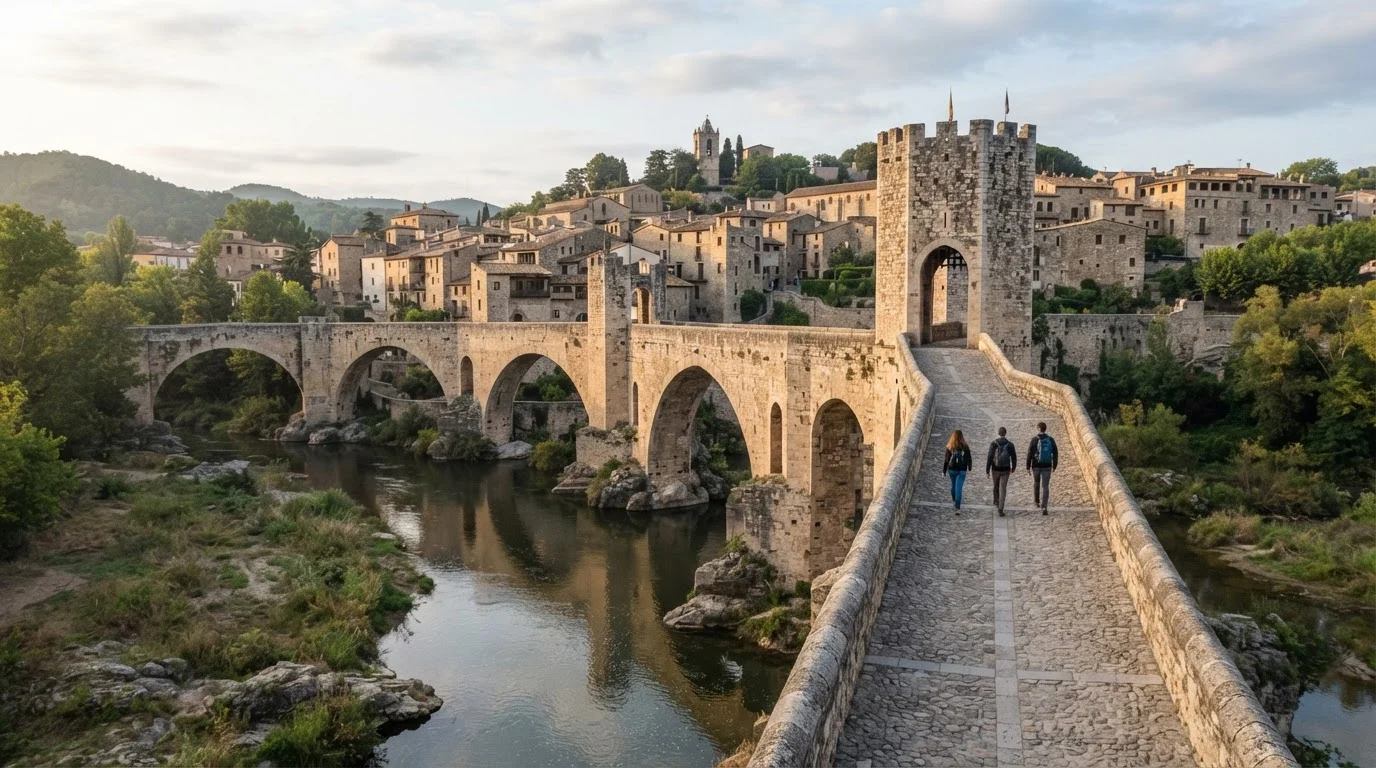
The fortified Romanesque bridge over the Fluvià river is the image that appears on almost every postcard of the town. It crosses the river at an angle, with a gate tower partway along, and leads straight into the old town. The best views are from the riverbank below, especially in the softer light of morning or late afternoon.
The Jewish quarter
Besalu had a Jewish community in the Middle Ages, and the quarter near the river keeps its narrow streets. The remains of a mikveh, a Jewish ritual bath, were found here and are one of the rare surviving examples in this part of Europe. Access to the mikveh is usually arranged through the local tourist office, so check with the Besalu tourist office directly for visiting arrangements on the day you plan to go.
The old town
Beyond the bridge, the old town is compact and easy to walk: arcaded squares, Romanesque churches and stone houses. The centre is largely pedestrian. A driver will set you down at a convenient point on the edge of the old town, and you continue on foot.
Castellfollit de la Roca on its basalt cliff
Castellfollit de la Roca is a short drive from Besalu toward Olot. The village sits along the top of a basalt cliff formed by ancient lava flows, above the meeting point of two rivers. The houses and the church run right to the edge of the rock.
The classic view is from below, looking up at the cliff face with the village on top. You can also walk into the village and out to the viewpoint at the end of the cliff, which looks back over the valley.
Most visitors spend less than an hour here, which is exactly why it fits a car-based day so well. By bus, a short stop at Castellfollit can mean a long wait for the next connection.
The Garrotxa Volcanic Zone Natural Park and Santa Pau
The natural park covers a landscape of extinct volcanoes, many of them now wooded hills. Two areas draw the most visitors.
The volcanoes near Santa Pau
The area between Olot and Santa Pau holds some of the best known cones in the park, including the Santa Margarida volcano, with a small hermitage in its crater, and the Croscat volcano, where a quarry cut once exposed its inner layers. Marked walking paths link several of these points. Some routes start from visitor car parks rather than from the villages, which is another reason a car helps.
The Fageda d'en Jordà
The Fageda d'en Jordà is a beech forest growing on an old lava flow. It is especially popular in autumn, when the leaves change color. The paths are gentle and suit most walkers.
Santa Pau village
Santa Pau itself is a small walled village with a porticoed main square and a castle. It is quieter than Besalu and makes a good stop for a coffee or an early lunch. The area is also known for its local beans, which appear on menus around the village.
For current trail information, visitor rules and any access changes, check with the Garrotxa Volcanic Zone Natural Park visitor service directly. Some paths and parking areas can be regulated at busy times.
Olot: the Garrotxa's working town
Olot is the largest town in the Garrotxa and the natural place for a sit-down lunch. It has volcanic cones within the town itself, the most visited being Montsacopa, with a short walk to a chapel and views over the rooftops. The town centre has shopping streets, squares and a tradition of religious art workshops.
Olot is also the turning point of the loop, east toward Besalu or south toward Vic.
Rupit or Vic as stops on the way
If you take the inland route through Vic, you can add one of two very different stops.
Rupit
Rupit is a stone village set in hills between Vic and the Garrotxa, with a hanging footbridge over a stream, cobbled lanes and houses built straight onto the rock. Visitors usually walk into the historic core from the edge of the village. Rupit adds a detour off the main road, so it suits a full day rather than a shorter booking.
Vic
Vic is a cathedral city with one of the largest main squares in Catalonia, the Plaça Major, lined with arcades. It is known for its cured sausages and its market. Vic sits right on the C-17, so it is an easy first or last stop with little extra driving.
How to plan the order of stops
The order you choose depends on two things: which stop you most want to see in good light, and which route out of Barcelona suits your morning.
Loop A: coast side first
Barcelona, AP-7 north toward Girona, Besalu, Castellfollit de la Roca, Olot, Santa Pau and the volcanoes, then back toward the AP-7 and Barcelona.
This puts Besalu early in the day, when the old town is at its quietest. It also suits travelers who want to add Girona, because Girona sits close to the AP-7 on the way out or the way back.
Loop B: inland first
Barcelona, C-17 north to Vic, Rupit (optional), C-37 toward Olot, Santa Pau and the volcanoes, Castellfollit de la Roca, Besalu, then the AP-7 back to Barcelona.
This route gives you the volcanic landscape in the middle of the day and Besalu in the late afternoon light. It works well if you want Vic or Rupit included.
Loop C: Besalu and Girona
Barcelona, AP-7 to Girona, the old town and the cathedral area, then on to Besalu and Castellfollit, and back.
This is the shortest of the three and suits a group that wants medieval towns more than volcanic walks.
Practical rules of thumb
- Put the place you care about most first, while energy is high.
- Keep lunch in a town with a choice of restaurants, such as Olot, Besalu or Vic.
- On weekends and public holidays, Besalu and the volcano car parks are busier, so an early start helps.
Half day vs full day by the hour
Chauffeur hire for this kind of trip is arranged by the hour or by the day, and every journey is quoted on request. The right length depends on how many stops you want.
| Plan | Typical stops | Booking format | Price |
|---|---|---|---|
| Shorter booking | Besalu and Castellfollit de la Roca | Chauffeur by the hour | Quoted on request |
| Full day, coast side | Besalu, Castellfollit, Olot, Santa Pau | Driver by the day | Quoted on request |
| Full day, inland | Vic or Rupit, Santa Pau, Castellfollit, Besalu | Driver by the day | Quoted on request |
| Besalu and Girona | Girona old town, Besalu, Castellfollit | Driver by the day | Quoted on request |
| Fixed tour: Medieval Girona and Dali Museum in Figueres | Girona and Figueres | Private tour, 10h, up to 10 guests | From EUR 825 per group |
| Fixed tour: Medieval Girona and Costa Brava | Girona and the Costa Brava | Private tour, 10h, up to 10 guests | From EUR 850 per group |
A shorter booking can work for Besalu and Castellfollit alone, but the Garrotxa is far enough from Barcelona that most travelers find a full day more relaxed. The full loop with Santa Pau, Olot and an inland stop is a full-day plan.
For how hourly hire is set up in practice, including how to describe a flexible itinerary when you ask for a quote, see how to arrange hourly chauffeur hire in Barcelona.
Combining Besalu with Girona
Girona is the obvious partner for Besalu. It has a walled old town, a large Jewish quarter of its own, the cathedral steps and the colored houses along the Onyar river. Pairing the two gives a day built around medieval Catalonia.
There are two ways to arrange it:
- Your own itinerary with a private driver. You choose how long to spend in each town and whether to add Castellfollit or the volcanoes. This is a chauffeur day, quoted on request.
- A fixed private tour. If you want a set plan with a known price, the Medieval Girona and Dali Museum private tour covers Girona and the Dali Museum in Figueres from EUR 825 per group, up to 10 guests, over 10h, with hotel pickup and drop-off in Barcelona. Medieval Girona and Costa Brava is the coastal alternative from EUR 850 per group, also 10h for up to 10 guests.
Neither fixed tour is built around Besalu, so if Besalu is the priority, a chauffeur day is the better match. If Figueres interests you as well, the guide to a Figueres and Dali Museum day trip by car explains how that town fits a northern route.
Parking and pedestrian-only old centres
The medieval centres on this route were built long before cars. Expect the following in general terms:
- Besalu. The old town around the bridge is mostly pedestrian. Visitors normally walk in from the edge of town.
- Rupit. Visitors usually walk into the historic core from outside the village.
- Girona. The Barri Vell, the old quarter, is largely pedestrian and steep in places.
- Santa Pau and the volcanoes. Some walking routes begin at visitor car parks, which can be regulated or busy at peak times.
- Olot and Vic. Both are larger towns with ordinary traffic and town centre streets, and the main squares are pedestrian.
With a private driver, the practical difference is that you are set down near where you want to walk rather than at a station or bus stop. Arrangements for parking on the day depend on each town's local rules and are worth discussing when you ask for a quote.
Practical planning advice
Start early. The Garrotxa is a real distance from Barcelona, and an early departure gives you more time on the ground and quieter streets in Besalu.
Wear proper shoes. Cobbles in Besalu and Rupit, steps in Castellfollit and forest paths near Santa Pau all call for comfortable walking shoes.
Check opening arrangements yourself. Museums, the Besalu mikveh and some churches have their own visiting arrangements. Confirm them with each local tourist office or site before the day.
Plan lunch. Restaurants in small villages may fill up on weekends. Olot, Besalu and Vic give the widest choice. The local cuisine of the Garrotxa, often called volcanic cuisine, makes use of local beans, potatoes and pork products.
Share the plan. When you ask for a quote, list the stops you want, the order you prefer and any must-sees. For broader options across Catalonia, the private driver in Barcelona page outlines how a driver by the journey or the day is arranged.
Conclusion
A Besalu day trip from Barcelona is at its best as a loop: the medieval bridge and Jewish quarter of Besalu, Castellfollit de la Roca on its basalt cliff, the volcanoes and beech woods around Santa Pau, lunch in Olot, and Rupit or Vic if the route runs inland. A private driver makes that loop practical in one day, and you set the order of stops.
To get a quote, send the route, the date and time, and the number of guests and bags through the contact page, or WhatsApp or call +34 632 93 79 41, or email [email protected]. Every chauffeur journey is quoted on request.
Questions travelers ask
How do I get to Besalu from Barcelona?
Besalu can be reached by private car with a driver, by self-drive, or by train to Girona followed by a regional bus. A driver usually heads north on the AP-7 toward Girona and then west to Besalu. Public transport works for Besalu alone, but connections make it hard to add Castellfollit de la Roca, Santa Pau or Olot on the same day.
Can Besalu and Castellfollit de la Roca be visited in one day by car?
Yes. Castellfollit de la Roca lies on the road between Besalu and Olot, so the two pair naturally. A day by car can also include Santa Pau and the volcanoes of the Garrotxa Volcanic Zone Natural Park, plus lunch in Olot. Rupit or Vic can be added when the route runs inland on the C-17.
Is a half day enough for a Garrotxa trip from Barcelona?
A shorter booking by the hour can cover Besalu and Castellfollit de la Roca, but most travelers find a full day more relaxed because the Garrotxa is inland beyond Girona. The full loop with Santa Pau, Olot and an inland stop such as Rupit or Vic is a full-day plan with a driver by the day.
How much does a private driver to Besalu cost?
Chauffeur Hire Barcelona quotes every chauffeur journey on request, including hourly and full-day hire. A quote needs the route, the date and time, and the number of guests and bags. Send these through the contact page, by WhatsApp or phone on +34 632 93 79 41, or by email to [email protected].
Is there a fixed-price private tour that includes Girona?
Yes. Medieval Girona and Dali Museum in Figueres costs from EUR 825 per group for up to 10 guests, and Medieval Girona and Costa Brava costs from EUR 850 per group for up to 10 guests. Both last 10h and include hotel pickup and drop-off in Barcelona. Neither is built around Besalu, so a chauffeur day suits a Besalu focus better.
Can cars drive into the old centres of Besalu and Rupit?
The old town of Besalu around the medieval bridge is mostly pedestrian, and the historic core of Rupit is closed to cars. Visitors walk in from the edge of each village. Girona's Barri Vell is also largely pedestrian. Local parking rules apply in each town and are worth raising when you ask for a quote.
What order of stops works best for a Garrotxa day?
Two loops work well. One goes north on the AP-7 to Besalu first, then Castellfollit de la Roca, Olot and Santa Pau. The other goes inland on the C-17 through Vic, with Rupit optional, then Santa Pau, Castellfollit and Besalu in afternoon light. A third option pairs Girona with Besalu.
Chauffeur Hire Barcelona
Your own car and driver, quoted on request
Airport, cruise port and station transfers, a driver by the hour, day trips and long-distance journeys from Barcelona, plus 12 private tours priced per group.