On this page
Barcelona to Valencia by car with a driver takes roughly four hours of driving, mostly on the AP-7 south along the coast past Tarragona and Castelló de la Plana. The train suits one or two people travelling light between stations. A car makes more sense for door to door trips, groups, heavy luggage and stops on the way.
Key takeaways
- The road route runs south from Barcelona on the AP-7, close to Tarragona, the Ebro Delta, Peníscola and Castelló de la Plana, then into València from the north.
- The route page on this site gives an estimate of about 349 km and about 4 hours from Plaça de Catalunya to València, based on OpenStreetMap road routing without traffic. Real times depend on traffic and the exact addresses.
- Rail operators such as Renfe run trains between Barcelona and València. Check the operator for current journey times and stations.
- A private car wins when you start or finish away from a station, travel with several people or a lot of luggage, or want to stop in Tarragona, the Ebro Delta or Peníscola.
- Valencia Airport and València city centre are different drop-off points, so say which one you need.
- Every chauffeur journey is quoted on request. The only fixed prices in this guide belong to the private tours, such as Roman Tarragona and Mediterranean Sitges from €865 per group of up to 10 guests.
How long is the drive from Barcelona to Valencia?
The honest answer is "about four hours at the wheel, plus whatever stops you make". The Barcelona to Valencia chauffeur page on this site sets out the route estimate: about 349 km and about 4 hours from Plaça de Catalunya, using OpenStreetMap road routing with no traffic. Treat that as a baseline, not a promise.
Three things stretch the real time. The first is getting out of Barcelona, where weekday rush hours on the ring roads and the C-31 or C-32 can add a noticeable chunk. The second is the approach to València, which gets busy at the same times of day. The third is breaks. Spain's traffic authority, the DGT, advises a break every 2 hours or 200 km, so a four hour drive normally includes at least one pause, and a sightseeing stop turns the trip into most of a day.
If you need to be in València at a fixed time, for a meeting, a ship or a flight, work backwards from that time and leave a margin. When you ask for a quote, give the arrival time you need and the journey can be planned around it.
Which route does a car take from Barcelona to Valencia?
Most of the trip is one long motorway. Leaving Barcelona, the usual line heads southwest along the coast and joins the AP-7, the Mediterranean motorway, near El Vendrell. From there it keeps south, passing close to Tarragona, Cambrils, the Ebro Delta around Amposta, Peníscola and Castelló de la Plana. Approaching Sagunt, the route moves onto the A-7, the Autovía del Mediterráneo, and enters València from the north.
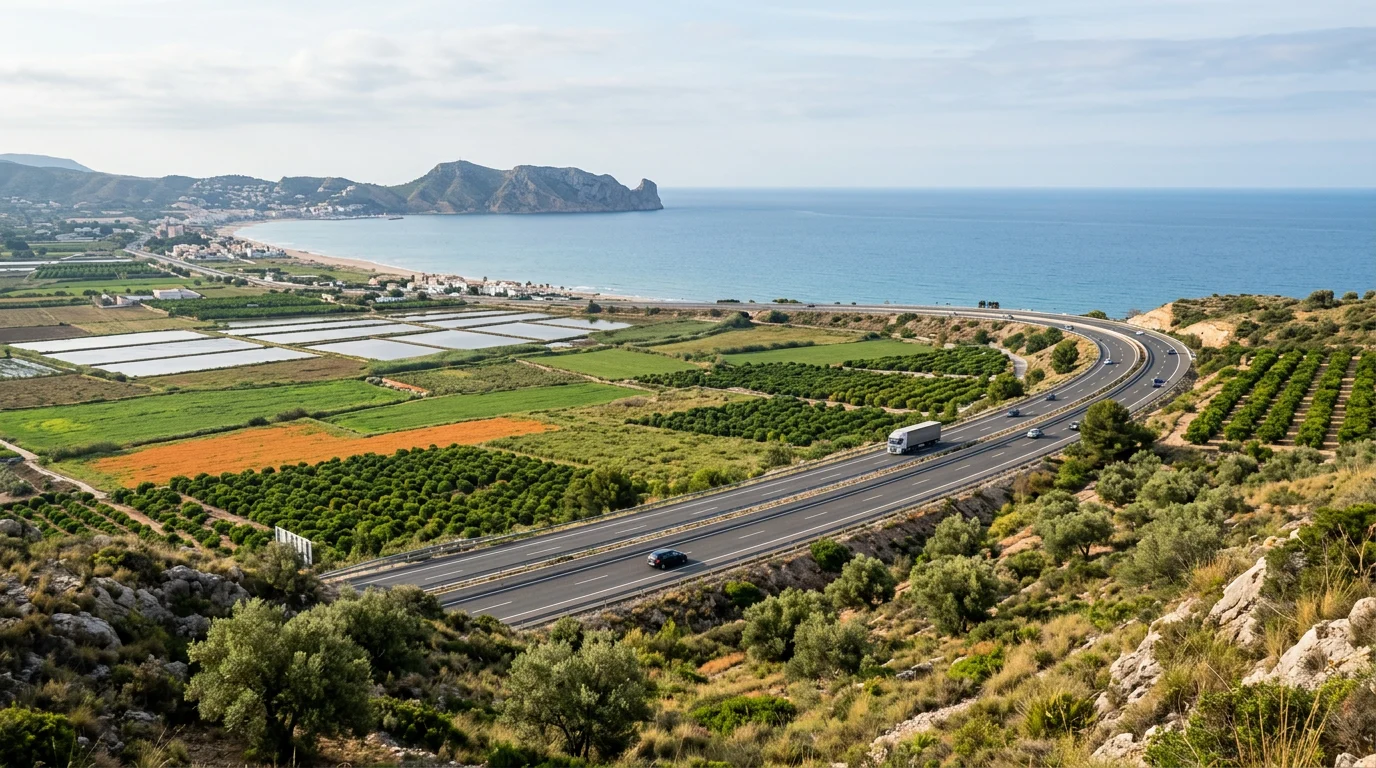
The scenery changes as you go. North of Tarragona the motorway runs a little inland of the beach towns of the Costa Daurada. South of the Ebro the landscape opens up into rice fields, then citrus groves become a common sight as you cross into the Valencian Community. The sea is often close but not always in view from the motorway itself, so if a coastal stretch matters to you, mention it and a short detour can be built in.
For distances and times on any specific variation of the route, rely on the road routing source you trust and on live traffic on the day. This guide keeps those figures general on purpose.
Barcelona to Valencia car or train: which makes sense?
Both options work. The right one depends on where you start, where you finish and what you are carrying.
When the train is the better choice
Trains run between Barcelona and València, and Renfe is the main operator to check for current services and journey times. The train suits you when:
- You are one or two people with light luggage.
- Your hotel in Barcelona is close to the departure station and your hotel in València is close to the arrival station.
- You want to work or rest without any break in the journey.
- You do not need to stop anywhere on the way.
The thing to watch is the station. Depending on the service, trains from Barcelona arrive at one of València's main stations, Joaquín Sorolla or Estació del Nord, so check your ticket. Fares, times and which station a given train uses are set by the operator, so always confirm them with the operator directly before you plan the rest of the day.
When a car with a driver is the better choice
A private car wins when the station to station logic breaks down. That happens more often than people expect:
- Door to door. A train still needs a ride to the station in Barcelona and another from the station in València. With a car, the journey starts at your hotel, home or office and ends at the exact address you give.
- Groups. For a family or a group of friends, separate tickets add up and everyone has to move together through two stations. One car keeps the group together from door to door.
- Luggage. Large suitcases, golf bags, prams or sports equipment are tiring to carry through stations and on and off trains. In a car they are loaded once at the start and unloaded once at the end. Tell us the number of bags when you ask for a quote so the right vehicle is planned.
- Stops on the way. A train does not stop for a walk around the Roman sites of Tarragona or lunch near the Ebro Delta. A car journey can include those stops in the plan.
- Awkward times. If you are coming off a cruise ship or a late flight, or need to leave early, a car can be planned around your timing rather than a timetable.
A quick comparison
| Option | Best for | Price |
|---|---|---|
| Train between Barcelona and València | One or two travellers, light luggage, hotels near the stations | Set by the rail operator; check Renfe |
| Barcelona to València chauffeur | Door to door, groups, luggage, stops on the way | Quoted on request |
| Barcelona Airport to València transfer | Landing in Barcelona and heading straight south | Quoted on request |
| Roman Tarragona and Mediterranean Sitges private tour | A separate day out from Barcelona, 10h | From €865 per group, up to 10 guests, hotel pickup and drop-off in Barcelona |
Door to door vs station to station
It helps to picture the whole day rather than only the part in the train or the car.
By train, a typical day looks like this: check out, take a taxi or the metro to the station, arrive early enough to find the platform, travel, arrive in València, then find another taxi or transfer to your hotel. Each change is a small step, but with children, older travellers or a lot of luggage, those steps are where the effort sits.
By car, the day is one step. You are collected where you are staying, you travel, and you arrive where you are going. The time on the road may be similar to the time you would spend on a train plus the two transfers at either end. For many groups the real difference is not the minutes but the number of times everyone has to pick up their bags.
If you are a solo traveller staying next to Barcelona Sants and heading to a hotel next to the station in València, the train will usually be simpler. If you are anywhere else, run through both versions of the day before you decide.
Luggage and groups
Two questions shape any long road trip: how many people, and how much luggage. The answers decide what kind of vehicle is planned, so send both when you ask for a quote. Be specific: "four adults, two children, five large suitcases and two cabin bags" is far more useful than "a family with luggage".
For groups, a private car also removes the coordination problem. Nobody has to be at a platform at an exact minute, and nobody gets separated in a station crowd. If your group is large, mention it early so the journey can be planned properly.
Stops between Barcelona and Valencia
The coast between Barcelona and València is one of the reasons to go by road. A stop breaks up the drive, follows the DGT advice on regular breaks, and gives you a taste of places you might not otherwise see. Here are the three most common ideas, described in general terms.
Tarragona
Tarragona sits on the coast about a third of the way south and is known for the remains of the Roman city of Tarraco: the amphitheatre above the sea, sections of the walls, and the old town on the hill. A stop of an hour or two lets you walk part of it and have a coffee or lunch before continuing.
A Tarragona stop on the way to València is a natural fit with sightseeing. If you would rather see Tarragona properly as a day out and come back to Barcelona the same evening, that is a different product: the Roman Tarragona and Mediterranean Sitges private tour runs for 10 hours and costs from €865 per group of up to 10 guests, with hotel pickup and drop-off in Barcelona. It is a separate day trip from Barcelona and not part of a transfer to València.
The Ebro Delta
South of Tarragona, the Ebro river reaches the sea in a wide, flat delta of rice fields, lagoons and long beaches, protected as a natural park. It lies off the motorway, so a visit is a detour rather than a quick stop. It suits travellers who like open landscapes, birdlife and a slower lunch. If you want to include it, say so in your request, because it changes the timing of the day more than a stop next to the motorway.
Peníscola
Further south, just inside the Valencian Community, Peníscola is a walled old town on a rocky headland with a castle at the top, surrounded on three sides by the sea. It sits a short way off the main route, and many travellers find it a good place to stretch their legs in the second half of the drive.
Planning stops sensibly
Each stop adds time. A coffee break might add half an hour, a walk through Tarragona's Roman sites a couple of hours, and a detour to the Ebro Delta with lunch could take a good part of the afternoon. Decide on the order of priorities: if you must reach València by a certain time, pick one stop, not three. Tell us which stops you want and roughly how long you would like at each, and the journey is quoted with them included in the plan.
Valencia Airport or the city centre?
València has two very different end points for a road trip from Barcelona, and it matters which one you give.
Valencia Airport is at Manises, west of the city. If you are flying out of València, give the airport as your destination, along with your flight time, and plan to arrive with the margin your airline recommends.
València city centre covers the old town, the area around the main stations, the City of Arts and Sciences, the beaches and the port. Give the exact address of your hotel, apartment, office or terminal rather than just "Valencia", because the city is spread out and the time to reach each area differs.
If you are arriving at Barcelona Airport and want to go straight to València without staying in Barcelona, the Barcelona Airport to València transfer starts at the terminal. Send the flight number and arrival time with your request so the pickup can be planned around it.
Cruise passengers ending in Barcelona
Many cruises start or finish in Barcelona, and some passengers want to continue to València rather than fly home from Barcelona. The usual choices are a taxi to the station and a train, or a car from the cruise terminal straight to València.
The case for a car is strongest here. After disembarkation you have all your luggage with you, the terminals are spread along the port, and a station transfer adds one more change with heavy bags. A car from the terminal to your address in València keeps it to one step. For background on how the terminals work and where they are, see the guide to Barcelona cruise terminals.
When you ask for a quote, give the name of your ship, the terminal if you know it, the date and the time you expect to be off the ship, plus the number of guests and bags.
One-way or return?
Most Barcelona to València journeys are one-way: people move between two cities as part of a longer trip around Spain, or travel south to fly home from València. Ask for exactly what you need.
A return journey makes sense in a few situations:
- A business day in València. You travel down in the morning, attend a meeting or a trade fair, and come back the same evening. Give the meeting address and the times so the plan works around them.
- A multi-day stay. You go down on one date and come back on another. Give both dates and times in one request.
- A long sightseeing day. Some travellers like to combine a stop on the coast with time in València and return the same day. That makes for a long day on the road, so think about whether a night in València would be more comfortable.
If your plans are still forming, say so. It is easier to plan a journey that includes the right details from the start than to change it later.
How does this compare with Barcelona to Madrid?
The logic is similar, but the balance shifts. Madrid is much further from Barcelona than València, so the train has a stronger case for that trip. For València, the drive is shorter and runs along the coast with natural places to stop, which makes the car a closer contest for many travellers. If you are weighing up both cities, the guide to Barcelona to Madrid by car with a driver or by high-speed train covers the longer route.
What to send for a quote
Every chauffeur journey from Barcelona is quoted on request. To get an accurate quote quickly, send:
- The route. The full pickup address in Barcelona (or the airport terminal, cruise terminal or station) and the full drop-off address in València (or Valencia Airport).
- The date and time. Either the time you want to leave or the time you need to arrive.
- Any flight, train or ship. The flight number, the train or the name of the ship, if your journey connects with one.
- Guests and bags. The number of adults and children, and the number and size of bags, including any bulky items.
- Stops. Any places you would like to stop on the way, such as Tarragona, the Ebro Delta or Peníscola, and roughly how long at each.
- One-way or return. If it is a return, give both dates and times.
Practical planning tips
- Check the train first if you are travelling light. Look up current times and stations with the operator, then compare the whole day, including transfers at both ends.
- Pick your stops before you book. One well chosen stop usually beats three rushed ones.
- Leave margin for fixed times. Ships, flights and meetings do not move, so plan the departure with time to spare.
- Be exact about addresses. Both Barcelona and València are spread out, and the exact address changes the timing.
- Think about the season. Summer weekends and holiday periods bring more traffic along the coast, so allow extra time.
- Keep the tour and the transfer separate in your head. The private tours return to Barcelona the same day; a transfer to València is a one-way or return journey quoted on its own.
Ready to plan the trip?
Barcelona to Valencia by car is a few hours on one coastal motorway, and it suits travellers who want door to door travel, room for luggage or a stop on the way. For a quote, send your route, date and time, any flight, train or ship, and the number of guests and bags by WhatsApp or phone on +34 632 93 79 41, by email to [email protected], or through the contact page.
Questions travelers ask
How long does it take to drive from Barcelona to Valencia?
The route page on chauffeurhirebarcelona.com estimates about 349 km and about 4 hours from Plaça de Catalunya to València, based on OpenStreetMap road routing with no traffic. Rush hours around both cities, the exact addresses and any breaks add time. The DGT, Spain's traffic authority, advises a break every 2 hours or 200 km, so plan at least one stop.
Is it better to take the train or a car from Barcelona to Valencia?
The train usually suits one or two people with light bags whose hotels sit close to the stations. A car with a driver suits families, groups, travellers with bulky luggage and anyone who wants a stop in Tarragona, the Ebro Delta or Peníscola. Compare the whole day, including the transfers to and from the stations, before choosing.
How much does a Barcelona to Valencia transfer cost?
Every chauffeur journey from Barcelona, including Barcelona to València and Barcelona Airport to València, is quoted on request. The price depends on the route, the date and time, any connection with a flight, train or ship, and the number of guests and bags. Send those details by WhatsApp, phone or email to receive a quote.
Can the journey include stops on the way to Valencia?
Yes, stops can be written into the plan when you ask for a quote. Common choices are Tarragona for its Roman remains, the Ebro Delta for rice fields and lagoons, and the walled old town of Peníscola. Each stop adds time, so list the places you want and roughly how long you would like to spend at each one.
Can I go straight from Barcelona Airport to Valencia?
Yes. The Barcelona Airport to València transfer starts at the terminal, so you do not need to go into Barcelona first. Include your flight number and arrival time with the request, plus the full drop-off address in València or Valencia Airport, the number of guests and the number of bags you are bringing.
Can cruise passengers travel from the Barcelona port to Valencia by car?
Yes. Passengers finishing a cruise in Barcelona can travel from the cruise terminal directly to an address in València, which avoids a separate trip to the station with all their luggage. When asking for a quote, give the ship name, the terminal if known, the date, the expected time off the ship and the number of guests and bags.
Is the Roman Tarragona private tour part of the Valencia transfer?
No. Roman Tarragona and Mediterranean Sitges is a separate private day tour from Barcelona that lasts 10 hours and costs from €865 per group of up to 10 guests, with hotel pickup and drop-off in Barcelona. A short Tarragona stop can be added to a València journey instead, and that journey is quoted on request.
Chauffeur Hire Barcelona
Your own car and driver, quoted on request
Airport, cruise port and station transfers, a driver by the hour, day trips and long-distance journeys from Barcelona, plus 12 private tours priced per group.