On this page
Barcelona to Alicante is a long run down Spain's Mediterranean coast, by road on the AP-7 motorway or by rail with Renfe. The train suits one or two people with light bags going city center to city center. A car with a driver suits groups, heavy luggage, villa addresses on the Costa Blanca and anyone who wants stops along the way.
Key takeaways
- The road route follows the AP-7 motorway south through Tarragona, Castellón and the Valencia area before it reaches Alicante. Expect most of a day once breaks are included.
- Renfe runs trains on the Mediterranean corridor between Barcelona Sants and Alicante. Check Renfe's own timetable for direct departures, journey times and fares on your date.
- A private driver collects you at your hotel, Barcelona Airport or Barcelona Sants and takes you to the exact address in Alicante, Benidorm, Altea or a villa inland.
- Stops on the way, such as Peniscola, a lunch in Valencia or a walk in Altea, are easy by car and awkward by train.
- Every chauffeur journey from Barcelona is quoted on request. A quote needs the route, the date and time, any flight or train, and the number of guests and bags.
Key facts at a glance
The table below compares the two ways to make the trip. Fares and timetables change, so the train column names Renfe as the source rather than giving figures.
| Question | Car with a driver | Train |
|---|---|---|
| Starting point | Your hotel, Barcelona Airport, Barcelona Sants or any address | Barcelona Sants station |
| Arrival point | The exact address you give, in Alicante or on the Costa Blanca | Alicante's main station |
| Route | AP-7 coastal motorway, with a choice of roads south of Valencia | Mediterranean rail corridor |
| Stops on the way | Planned into the day, such as Peniscola, Valencia or Altea | Only where the train stops |
| Luggage | Bags stay in the car from door to door | You carry bags on and off the train |
| Timetable | You choose the start time | Renfe sets departures and journey times |
| Price | Quoted on request for the route, date, guests and bags | Fares published by Renfe |
| Best fit | Groups, families, heavy bags, villa addresses, stops | One or two people with light bags |
For the exact road distance and the drive time on your date, use a route planner and Spain's traffic authority, the DGT, which publishes road conditions and works. For trains, Renfe is the only source to trust for the current timetable.
How long is the drive from Barcelona to Alicante, and which road does it take?
The drive is one of the longer journeys this service covers from Barcelona, so plan it as a full travel day rather than a quick hop. Without stops it fills a long morning or a long afternoon. With a coffee break, a lunch and a short walk somewhere on the coast, it fills most of the day.
The AP-7 down the coast
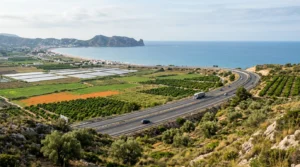
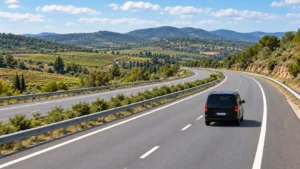
The main road is the AP-7, the motorway that runs along Spain's Mediterranean coast. From Barcelona it heads southwest past the Garraf coast and Tarragona, crosses the Ebro Delta area, and continues through the province of Castellón, past Peniscola and Castellón de la Plana.
Around Valencia the motorway skirts the city to the west. South of Valencia, drivers have two broad choices. One stays inland on the A-7 through the hills toward Alicante. The other follows the AP-7 nearer the coast, past Dénia, Altea and Benidorm. Which one makes sense depends on traffic, on where in Alicante province you are going, and on whether you want to stop by the sea.
What affects the drive time
Several things change the length of the day:
- Start time. Leaving Barcelona before the morning rush avoids the slowest stretch of the trip, which is often getting out of the city.
- Day of the week. Friday afternoons and Sunday evenings in summer bring heavier traffic around Valencia and on the coastal stretches.
- Roadworks. The DGT lists planned works and incidents on the AP-7 and the A-7.
- Stops. A lunch in Valencia or a walk in Peniscola adds time, and for many travelers that is the point of going by car.
- Final address. A hotel in central Alicante is quick to reach from the motorway. A villa in the hills behind the Costa Blanca can take longer to find on small roads.
A driver plans the route on the day around these factors. The quote you receive reflects the route you describe, so mention any stops and the full destination address when you ask.
Is there a direct train from Barcelona to Alicante?
Renfe, the Spanish national rail operator, runs services on the Mediterranean corridor between Barcelona Sants and Alicante, including Euromed and Intercity trains. Some departures are direct and some need a change, usually in Valencia. The mix of trains, the stops and the journey times change with the season and with works on the line.
The only reliable way to know what runs on your date is Renfe's own website or app. Third-party booking sites show Renfe trains too, but Renfe is the source for timetables, platform changes and fares.
What the train does well
- It runs city center to city center, from Barcelona Sants to Alicante's main station.
- It avoids motorway traffic around Barcelona and Valencia.
- For one or two people with a small bag each, it is simple and predictable.
- You can read, work or sleep on the way.
Where the train is harder
- You need to get to Barcelona Sants first, with your bags, at a set time.
- If your train involves a change, bags go off one train and onto another.
- Alicante's station is in the city. If you are staying in Benidorm, Altea, Jávea or a villa inland, you still need onward transport at the far end.
- You cannot stop in Peniscola or have a long lunch in Valencia without breaking the journey and buying separate tickets.
If you plan to take the train but want help at the Barcelona end, a Barcelona Sants station transfer can take you and your bags from your hotel to the station.
Where can you stop on the way down the coast?
One of the main reasons to make this trip by road is the coast itself. These are the stops that fit most naturally into a Barcelona to Alicante day by car.
Tarragona
Tarragona sits on the coast southwest of Barcelona and keeps a large Roman heritage: an amphitheater above the sea, sections of the old walls and the remains of the Roman circus. It makes an early stop for a coffee and a short look at the amphitheater before the longer stretch south.
The Ebro Delta
The Ebro Delta is a flat landscape of rice fields, lagoons and long beaches where the river meets the sea. It sits a little off the motorway, so it works better as a detour for those who are keen on birdlife or open landscapes than as a quick stop.
Peniscola
Peniscola is a walled old town on a rocky headland, crowned by a castle linked to the Templars and to Pope Benedict XIII, known as Papa Luna. The old town is compact, so a walk up to the castle and along the walls fits into a stop of moderate length. It is one of the most popular breaks on the whole route.
Valencia
Valencia is the natural lunch stop, and the home of paella. A driver can drop you near the old town for a walk past the cathedral and the Central Market, or near the City of Arts and Sciences. Valencia is a big city, so pick one area rather than trying to see several. For the Valencia leg on its own, the guide to Barcelona to Valencia by car or by train covers that route in more detail.
Altea and Benidorm
If the coastal road is chosen south of Valencia, Altea and Benidorm fall near the end of the day. Altea has a whitewashed old town on a hill, with a church known for its blue tiled domes. Benidorm is a resort town of tall towers and long beaches. Many travelers going to the Costa Blanca are staying in or near these towns rather than in Alicante city, which is a strong reason to go by road.
How many stops fit in one day?
On a single travel day, one longer stop plus one or two short breaks is a comfortable plan. A typical pattern is a coffee in Tarragona, a walk in Peniscola, and then a straight run to Alicante. Another is a direct run to Valencia for lunch and a walk, then onward. Trying to see Tarragona, Peniscola, Valencia and Altea in one day turns the trip into a long series of short stops.
Car with a driver or train: which fits your group and your bags?
The right choice depends more on who is traveling and where they are going than on the route itself.
The train usually fits when
- You are one or two people.
- Each person has a small bag they can lift onto a luggage rack.
- You are staying in central Alicante, close to the station.
- Your dates are fixed and you are happy with the departure times Renfe offers.
A car with a driver usually fits when
- You are a family or a group, and train tickets for everyone plus taxis at both ends start to add up in cost and effort.
- You travel with large suitcases, golf bags, a stroller or other bulky items.
- Someone in the group finds stations, stairs or changes difficult, such as an older relative.
- Your destination is a villa, an apartment or a hotel outside Alicante city.
- You want to stop on the way and see the coast.
- You are arriving at Barcelona Airport and want to head south straight away, without going into the city first.
Comparing the effort, not just the price
When people compare the train and a car, they often compare the train fare with the car quote and stop there. The full picture includes getting to Barcelona Sants, handling bags at each change, and getting from Alicante station to the final address. For a couple with light bags, the train often wins on simplicity. For a family of five with luggage heading to a villa near Altea, door-to-door travel usually wins.
There is no single right answer. Ask for a quote for the exact route, then set it against the train fares Renfe shows for your date and the onward transport you would need.
Barcelona Airport to Alicante: going south on arrival
Some travelers fly into Barcelona and want to reach Alicante or the Costa Blanca the same day. By train, that means getting from Barcelona Airport to Barcelona Sants, then boarding a train south, then making your way from Alicante station to the final address.
By car, the driver starts at Barcelona Airport and heads directly south, without passing through the city center. If your flight times are known when you ask for a quote, include the flight number and the scheduled arrival time, along with the number of guests and bags. Mention which terminal you land at, since Barcelona Airport has two.
The return trip and Alicante-Elche Airport
Alicante-Elche Airport serves Alicante and the Costa Blanca, with flights across Europe. Many travelers fly home from there rather than going back to Barcelona. If your trip is one way, Barcelona to Alicante by road and then a flight home from Alicante-Elche is a common pattern. Check the airport's official site and your airline for flight details.
If you need to return to Barcelona at the end of the stay, the same road trip in reverse can be quoted on request.
Planning tips for the trip
Choose a sensible start time
An early start gives you daylight for stops and a calm arrival. For a direct run with one break, a mid-morning start still works. For a day with a longer lunch in Valencia and a walk in Peniscola, start earlier.
Decide the pickup point
A driver can start from your hotel in Barcelona, from Barcelona Airport, from Barcelona Sants or from any other address in Greater Barcelona. If you are leaving Barcelona after a cruise, say so when you ask for a quote and name the terminal from your cruise documents.
Give the full destination address
"Alicante" covers a big area. A hotel in the city center, an apartment in San Juan beach, a villa in the hills behind Jávea and a resort in Benidorm are very different final legs. The full address makes the quote accurate and the arrival smoother.
Say which stops you want
If you want lunch in Valencia or a walk in Peniscola, include that when you ask. A stop is part of the route, so it belongs in the quote from the start rather than as a change on the day.
List the luggage honestly
The number of bags matters for the right vehicle. Count suitcases, carry-ons, strollers, golf bags and any other large items, and include them in the request.
Check trains and roads on the day
If you go by train, check the Renfe app on the morning of travel for any changes. If you go by road, the DGT publishes current traffic and incidents.
Think about the season
In summer, the coastal stretches and the Costa Blanca resorts are busy, and traffic around Valencia can be heavier on weekends. Outside the summer months, the drive is usually calmer and the stops less crowded.
When a private car fits better
A private car with a driver is not always the right choice for Barcelona to Alicante, but it fits better than the train in several clear cases.
Families and groups. One vehicle carries the whole group and its bags from door to door. Nobody has to keep track of tickets, platforms or a change in Valencia.
Heavy luggage. Large suitcases, golf bags and strollers stay in the car for the whole day.
Older travelers or limited mobility. No stairs at stations, no rush between trains and no walking with bags from the platform to a taxi rank.
Villa and resort addresses. If you are staying in Benidorm, Altea, Dénia, Jávea or a villa inland, the car takes you there directly.
A day with stops. Peniscola, Valencia and Altea become part of the trip rather than places you pass on the train.
Arriving by air or sea. Starting directly from Barcelona Airport or a cruise terminal saves a trip into the city before heading south.
The service area includes long-distance journeys from Barcelona, and the long-distance journeys from Barcelona page lists other routes. The Barcelona to Alicante chauffeur page covers this route specifically.
How this compares with other long routes from Barcelona
Barcelona to Alicante belongs to a family of long road journeys out of the city. It is longer than the run to Valencia, which is a natural break point on the same road. It is a coastal route rather than an inland one, which sets it apart from the drive to Madrid. If you are weighing several Spanish cities, the guide to Barcelona to Madrid by car or high-speed train explains how the train and the car compare on that route, where the high-speed line changes the picture.
On the Alicante route, the train and the car are closer competitors than on the Madrid route, because the coast offers stops worth making and many travelers are heading to towns away from the station.
Sources
- Renfe, the Spanish national rail operator, for the current timetable, journey times, direct and connecting services, and fares between Barcelona Sants and Alicante.
- DGT (Dirección General de Tráfico), Spain's traffic authority, for road conditions, roadworks and incidents on the AP-7 and A-7.
- Alicante-Elche Airport, through the airport's official site and your airline, for flight details on the return trip.
Conclusion
Barcelona to Alicante works well by train for one or two people with light bags going from city center to city center, and Renfe is the place to check what runs on your date. For a family, a group, heavy luggage, a villa on the Costa Blanca or a day with stops in Peniscola or Valencia, a car with a driver makes the trip a single door-to-door journey. To plan yours, ask for a quote with the route, date and time, any flight or train, and the number of guests and bags, or WhatsApp or call +34 632 93 79 41.
Questions travelers ask
How do you get from Barcelona to Alicante?
There are two practical ways. Renfe trains run from Barcelona Sants to Alicante's main station on the Mediterranean corridor, and a car with a driver takes the AP-7 motorway down the coast from any address in Barcelona. The train suits light travelers heading to central Alicante, while the car suits groups, luggage and Costa Blanca addresses.
Is there a direct train from Barcelona to Alicante?
Renfe runs Euromed and Intercity services on this corridor, and some departures are direct while others need a change, usually in Valencia. Because the timetable shifts with the season and with works on the line, Renfe's website or app is the place to confirm direct trains, journey times and fares for your travel date.
Which road does a driver take from Barcelona to Alicante?
The usual route is the AP-7 motorway, heading southwest past Tarragona, the Ebro Delta area and Castellón, then around Valencia. South of Valencia the driver picks either the inland A-7 or the AP-7 nearer the coast past Benidorm, depending on traffic and on where in Alicante province you are staying.
Can you stop in Valencia or Peniscola on the way?
Yes, by car. Peniscola, with its castle on a rocky headland, and Valencia, the natural lunch stop, both sit close to the route. One longer stop plus a short break or two makes a comfortable day. Mention the stops when you ask for a quote, because they become part of the planned route.
Can a driver pick up at Barcelona Airport and go straight to Alicante?
Yes. Barcelona Airport is one of the possible starting points, so you can head south on arrival without going into the city first. Include the flight number, the scheduled arrival time, the terminal, the number of guests and the number of bags in your request so the quote reflects the real journey.
How much does a private driver from Barcelona to Alicante cost?
Every long-distance chauffeur journey from Barcelona is quoted on request rather than from a fixed list. The quote depends on the route, the date and time, any stops, and the number of guests and bags. Send those details by WhatsApp, phone on +34 632 93 79 41, or email [email protected].
Is the train or the car better for a family going to the Costa Blanca?
For a family with suitcases staying in Benidorm, Altea, Jávea or a villa inland, a car with a driver is usually simpler, since bags stay in one vehicle and nobody changes trains. The train fits better for one or two people with small bags who are staying close to Alicante's main station.
Chauffeur Hire Barcelona
Your own car and driver, quoted on request
Airport, cruise port and station transfers, a driver by the hour, day trips and long-distance journeys from Barcelona, plus 12 private tours priced per group.