On this page
Barcelona to Marseille is a long cross-border journey with two practical options besides driving yourself: a private driver who takes you door to door on the AP-7 and the French motorways, or a high-speed train from Barcelona Sants to Marseille Saint-Charles. The right choice depends on your luggage, your group and whether you want to stop along the way.
Key takeaways
- By road, the route runs north from Barcelona on the AP-7 past Girona to La Jonquera, crosses into France, then follows the French A9 past Perpignan, Narbonne, Montpellier and Nîmes before the A54 and A7 bring you through Arles and into Marseille.
- For the current driving distance and journey time, use the route planners published by the motorway operators: Vinci Autoroutes on the French side and the Spanish Directorate-General for Traffic (DGT) for traffic conditions in Catalonia.
- High-speed trains connect Barcelona Sants and Marseille Saint-Charles. Renfe and SNCF publish the current timetables and fares, so look there before you plan around a departure.
- A private driver makes most sense for families, groups, heavy luggage, door-to-door pickup at a hotel or villa, and stopovers in places such as Girona, Figueres, Collioure, Narbonne or Arles.
- The train makes most sense for solo travelers and couples with light bags who are happy to start and finish at a city-center station.
- Every chauffeur journey from Barcelona is quoted on request. A quote needs the route, the date and time, any flight or train, and the number of guests and bags.
How far is Marseille from Barcelona?
Marseille sits on the French Mediterranean coast, well beyond the Spanish border, and the drive is a full travel day for most people once breaks are included. It is a longer trip than Barcelona to Montpellier and shorter than Barcelona to Nice, which puts it in the middle of the coastal routes that travelers commonly plan out of Barcelona.
For an exact figure, the most reliable sources are the official route planners. Vinci Autoroutes, the operator of the A9, A54 and A7 motorways in the south of France, publishes a route calculator with the distance and an estimated driving time. On the Spanish side, the DGT (Dirección General de Tráfico) publishes live traffic information for the AP-7 and the roads leading to the border. These figures change with road works, traffic and the exact start and end points, so it is worth looking them up close to your travel date rather than relying on an old number.
What matters more in practice is how the day is structured. A chauffeured drive with one or two stops tends to fill most of a day, while a direct drive with short breaks leaves time to settle into Marseille in the afternoon or evening.
What is the driving route from Barcelona to Marseille?
The road route is simple to describe and well signed the whole way. It follows the coast at a distance, crossing Catalonia, the Roussillon, Languedoc and the edge of Provence.
Barcelona to the French border
From Barcelona, the drive heads north on the AP-7, the main motorway along the Catalan coast. It passes inland of the Maresme and the southern Costa Brava, skirts Girona and continues past Figueres toward La Jonquera, the last Spanish town before the border at Le Perthus.
This stretch is familiar to anyone who has taken a day trip from Barcelona to Girona or to the Dali Theatre-Museum in Figueres. Traffic out of Barcelona can be slow at peak hours, so an early start or a mid-morning departure after the rush often makes the first hour calmer.
Across the border and along the French A9
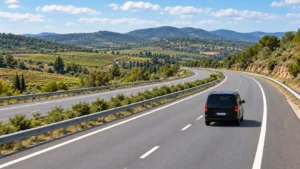
After La Jonquera, the motorway becomes the French A9, known as La Languedocienne. It drops out of the Pyrenean foothills toward Perpignan, then runs north past Narbonne and Béziers and on to Montpellier and Nîmes. This is the longest single section of the drive and the part where most travelers stop for a break.
Spain and France are both in the Schengen area, so there is usually no routine border control on this crossing. Identity checks can still take place, and the entry rules depend on your nationality. Carry a valid passport or national identity card, and read the entry requirements published by the French government before you travel.
Nîmes, Arles and the final run into Marseille
Near Nîmes, the route leaves the A9 and takes the A54 east toward Arles and Salon-de-Provence. The A54 passes close to the northern edge of the Camargue, the wetland delta of the Rhône. From there, the A7 runs south into Marseille, ending near the city center and the Old Port.
Arriving in Marseille by road, the last part of the journey is through city traffic. A private driver will take you straight to your hotel, apartment or the cruise terminal, which matters more in a busy port city than it does on the open motorway.
Is there a direct train from Barcelona to Marseille?
High-speed rail services run between Barcelona Sants and Marseille Saint-Charles. They use the cross-border high-speed line through the Pyrenees, then continue on the French network along the coast. Both Renfe and SNCF operate services on this route.
Depending on the service, trains may call at stations along the way such as Girona, Figueres, Perpignan, Narbonne, Montpellier and Nîmes. The stopping pattern, departure times and the number of daily trains vary by season and by operator, so treat any timetable you read in a blog or forum as a starting point only. Renfe and SNCF publish the current timetables and fares on their own booking channels, and those are the sources to use before you commit to a train.
A few practical points apply whichever operator you choose:
- Barcelona Sants is the departure station in Barcelona, and Marseille Saint-Charles is the arrival station in Marseille. Both are large city stations, and Saint-Charles sits on a hill above the city center with a long flight of steps on one side.
- Luggage on high-speed trains is limited by the space on board and by each operator's own rules. Renfe and SNCF publish their luggage rules, and it is worth reading them if you travel with large cases, ski bags or prams.
- You still need to get from your hotel to Barcelona Sants, and from Marseille Saint-Charles to your final address. For families with heavy bags, those two short legs are often the hardest part of the day.
If you choose the train, the Barcelona end can still be handled by car. A transfer to Barcelona Sants station takes you from your hotel to the station with your bags, planned around your departure.
Train, private driver or self-drive: how do they compare?
The table below compares the three main ways to travel from Barcelona to Marseille. It covers how each option works rather than cost, because chauffeur journeys are quoted on request and train fares are set by Renfe and SNCF.
| Point of comparison | High-speed train | Private driver | Self-drive rental car |
|---|---|---|---|
| Start and end point | Barcelona Sants to Marseille Saint-Charles | Your door in Barcelona to your door in Marseille | Rental desk to your address, then a return or drop-off |
| Luggage | Limited to what you can carry on board, under each operator's rules | Goes from door to door with you; list your bags when you ask for a quote | Whatever fits in the car you rent |
| Stops along the way | Only the stations the train calls at | Stops can be planned into the route, such as Girona, Collioure or Arles | Any stop you choose, but you drive and park |
| Who drives | Nobody in your group | A professional driver | You or someone in your group |
| Border and motorways | Handled by the rail operator | Handled by the driver | You navigate the AP-7, A9, A54 and A7 yourself |
| Arriving in Marseille | Station on a hill above the center, then a taxi or metro | Straight to your hotel, apartment or the port | City traffic and parking in Marseille |
| Who books what | You book tickets with Renfe or SNCF | You request one quote for the whole journey | You book the car and confirm one-way and cross-border rules with the rental company |
| Where to look up details | Renfe and SNCF timetables and fares | A quote from Chauffeur Hire Barcelona | Vinci Autoroutes and the DGT for routes and traffic |
Which stops are worth making on a chauffeured drive?
One of the clearest reasons to travel by road is the chance to break the journey in places the train passes without stopping long enough to see. You can tell us your preferred stops when you request a quote, and the journey is planned around them.
Girona
Girona is the first natural stop north of Barcelona. Its old town sits on the east bank of the Onyar river, with the cathedral steps, the old Jewish quarter and the colored houses along the river. A short walk through the old town makes a gentle start to the day. For the Girona leg alone, the guide to Barcelona to Girona by car with a driver or by train covers the route in detail.
Figueres
Figueres is close to the AP-7, a little further north. It is best known for the Dali Theatre-Museum, the museum Salvador Dali designed in his home town. A visit there takes real time, so it suits travelers who are happy to arrive in Marseille later in the day. Look up opening times and tickets on the museum's own website before you plan around it.
Collioure
Just over the border, Collioure is a small harbor town on the Côte Vermeille, with a castle by the water and a church tower that stands on the shore. It sits off the motorway, down the coast road from Perpignan, so it adds a detour. For travelers who want a sea view on the way, it is one of the most rewarding stops. The guide to Barcelona to France by car through Perpignan and Collioure looks at that part of the coast more closely.
Narbonne
Narbonne lies right by the A9 and is an easy stop for a meal or a walk. The old town has the unfinished Saint-Just cathedral and a stretch of the old Roman road, the Via Domitia, uncovered in the main square. Because it is so close to the motorway, it suits travelers who want a break without a long detour.
Arles
Arles sits on the A54 near the end of the route. Its Roman arena and theater stand in the middle of the old town, and the streets were painted by Vincent van Gogh. Stopping here puts a final break in the drive before the last section into Marseille.
The edge of the Camargue
South of Arles, the Camargue opens out into flat wetlands, salt marshes and lagoons. A full visit is a trip of its own, but a short look at its northern edge from the Arles side gives a sense of the landscape.
One or two stops are usually enough to keep the drive comfortable.
When does a private driver make sense for Barcelona to Marseille?
A private driver is the better fit in several common situations.
You have a lot of luggage. Long stays, cruise trips and family holidays often mean several large cases. On the train, those bags have to be carried through two big stations and lifted on and off. By car, they go from your hotel lobby to your next address.
You travel as a family or group. For a family with children or a group of friends, a single vehicle keeps everyone together, and nobody has to manage tickets, platforms or connections. Tell us the number of guests and bags when you ask for a quote, so the journey is planned for your group.
You want door to door. If you are staying outside central Barcelona, in a villa on the coast or a hotel far from Sants, or if your Marseille address is far from Saint-Charles, door-to-door travel removes two extra transfers from the day.
You want stopovers. The train only stops where its timetable says. With a driver, stops in Girona, Figueres, Collioure, Narbonne or Arles can be part of the plan.
You are connecting with a cruise or flight. Marseille is a major cruise port, and Barcelona is too. If you are joining or leaving a ship, a door-to-door car avoids one more change of transport on an already busy day. Give us your ship or flight details with your request so the journey is planned around them.
When is the train the better choice?
The train is often the simpler option when:
- You travel alone or as a couple with light bags.
- Your hotel in Barcelona is close to Barcelona Sants, and your stay in Marseille is close to Saint-Charles.
- You want to read, work or rest without stops along the way.
- You prefer to book directly with Renfe or SNCF and travel on a fixed timetable.
There is no single right answer. Some travelers mix the two: a car to Barcelona Sants, the train to Marseille, and a taxi at the other end. Others take the train one way and a private driver the other, so they can stop in Arles or Collioure on the return.
How to plan a Barcelona to Marseille drive
A few planning points make the day smoother, whichever way you travel.
Choose your departure time with traffic in mind
Leaving Barcelona very early or mid-morning, after the commuter traffic, usually gives a calmer first hour. Summer weekends and the start and end of French and Spanish holiday periods bring heavier traffic on the AP-7 and the A9. The DGT and Vinci Autoroutes both publish live traffic information.
Decide on stops before you request a quote
If you want to stop in Girona, Figueres, Collioure or Arles, mention it when you ask for a quote. Stops change the length of the day, and it is better to plan them in from the start.
Know your Marseille address
Marseille is a large city with busy, narrow streets in the center. Give the exact address of your hotel, apartment or cruise terminal, so the arrival is planned to the right door.
If you self-drive
If you prefer to rent a car and drive yourself, confirm the rental company's rules for taking a car from Spain into France and for one-way drop-offs, as both can be restricted. Some French cities apply low-emission rules to certain vehicles. The French government's Crit'Air service explains which vehicles need a sticker and where the rules apply. Barcelona has its own low-emission zone too, so a rental car picked up in the city also needs to meet the local rules published by the Barcelona metropolitan authorities.
How is a Barcelona to Marseille journey different from Montpellier or Nice?
The three routes share the AP-7 and the French A9 for much of the way, but they suit different trips. Montpellier is the shortest of the three and often works as a one-way transfer with a single stop. The guide to Barcelona to Montpellier by private driver or train covers that shorter option.
Marseille adds the A54 and A7 and the final run past Arles and the Camargue, so it is a longer day and leaves more room for stops in Provence. Nice is further still along the coast, past Marseille and the Côte d'Azur, which is why the guide to Barcelona to Nice by car with a driver or by train treats it as a separate journey.
How do you request a quote for Barcelona to Marseille?
Every chauffeur journey from Barcelona is quoted on request, including long-distance trips into France. To get an accurate quote, send:
- The route: your pickup address in Barcelona and your drop-off address in Marseille.
- The date and time: when you want to leave, and any time you need to arrive by.
- Any flight, train or ship: for example, a flight landing at Barcelona Airport or a cruise departing from Marseille.
- The number of guests and bags: including large cases, prams or sports equipment.
- Any stops: such as Girona, Figueres, Collioure, Narbonne or Arles.
More on the route itself is on the Barcelona to Marseille transfer page.
Planning the trip
Barcelona to Marseille works well by train and by road. The high-speed train between Barcelona Sants and Marseille Saint-Charles suits light travelers who start and end near those stations, and Renfe and SNCF are the places to look up timetables and fares. A private driver suits families, groups, heavy luggage, door-to-door travel and anyone who wants to see Girona, Collioure or Arles on the way.
To request a quote for your journey, WhatsApp or call +34 632 93 79 41, or email [email protected] with your route, date and time, any flight, train or ship, and the number of guests and bags.
Questions travelers ask
How far is Marseille from Barcelona by road?
Marseille is a long cross-border drive from Barcelona, and with breaks it fills most of a travel day. For the current distance and an estimated driving time, use the route calculator published by Vinci Autoroutes, which runs the A9, A54 and A7 in France, and the DGT live traffic information for the AP-7 in Catalonia before you set off.
Which roads does the Barcelona to Marseille drive use?
The drive goes north on the AP-7 past Girona and Figueres to La Jonquera and the French border. In France it follows the A9 past Perpignan, Narbonne, Montpellier and Nîmes, then the A54 toward Arles and the A7 south into Marseille, finishing close to the city center and the Old Port.
Is there a high-speed train from Barcelona to Marseille?
Yes, high-speed services link Barcelona Sants and Marseille Saint-Charles, and both Renfe and SNCF run trains on the route. Departure times, stops and fares change with the season and the operator, so look up the current timetables and fares directly with Renfe and SNCF rather than relying on figures quoted elsewhere.
Should I take the train or a private driver to Marseille?
The train suits solo travelers and couples with light bags who stay near Barcelona Sants and Marseille Saint-Charles. A private driver suits families, groups and travelers with several large cases, anyone staying away from those stations, and people who want to stop in Girona, Collioure or Arles on the way.
Can a chauffeured drive to Marseille include stops?
Yes. Stops can be planned into the route when you ask for a quote. Popular choices are Girona, Figueres for the Dali Theatre-Museum, Collioure on the coast just past the border, Narbonne beside the A9, and Arles near the edge of the Camargue. One or two stops usually keep the day comfortable.
How much does a private transfer from Barcelona to Marseille cost?
Every chauffeur journey from Barcelona, including long-distance trips into France, is quoted on request rather than from a fixed list. To receive a quote, send the route, the date and time, any flight, train or ship you need to connect with, and the number of guests and bags, plus any stops you would like to make.
How do I request a quote for Barcelona to Marseille?
Send your pickup and drop-off addresses, your travel date and time, any flight, train or ship details, and the number of guests and bags. You can WhatsApp or call +34 632 93 79 41, or email [email protected]. Mention any stops along the route so they are included in the plan.
Chauffeur Hire Barcelona
Your own car and driver, quoted on request
Airport, cruise port and station transfers, a driver by the hour, day trips and long-distance journeys from Barcelona, plus 12 private tours priced per group.