On this page
Barcelona to San Sebastian is about 510 to 570 km by road, depending on the corridor, or roughly six to six and a half hours of driving without traffic, according to OpenStreetMap road routing. Renfe's open timetable data shows a through Alvia train from Barcelona-Sants taking about 6 hours 30 minutes.
Key takeaways
- Distance by road: about 512 km on the shortest routed line through Huesca and Pamplona, and about 570 km on the AP-2 corridor through Lleida and Zaragoza (OpenStreetMap road routing, OSRM).
- Drive time: roughly 6 hours 15 minutes to 6 hours 35 minutes without traffic or breaks on those two lines, by the same routing estimate.
- Train: Renfe's open timetable data lists a through Alvia from Barcelona-Sants to San Sebastián-Donostia, timetabled at about 6 hours 29 to 6 hours 44 minutes, with stops including Zaragoza Delicias and Pamplona/Iruña.
- Natural stops: Zaragoza, Pamplona, Olite and the Bardenas Reales all sit near the road corridors and can turn a long transfer into a day with a plan.
- Private driver fit: larger bags, families, groups, a wish to stop on the way, or an onward leg to Bilbao.
- Quote: every chauffeur journey is quoted on request with the route, date and time, any flight or train, and the number of guests and bags.
How far is San Sebastian from Barcelona?
San Sebastián, called Donostia in Basque, is the capital of Gipuzkoa and sits on the Bay of Biscay close to the French border. Barcelona sits on the Mediterranean on the opposite side of northern Spain. The journey between them crosses Catalonia, Aragón (or a corner of it) and Navarre before it drops into the Basque Country.
How far it is depends on which corridor you follow. OpenStreetMap road routing (the OSRM planner, no traffic) gives three useful figures from central Barcelona:
- Through Huesca and Pamplona: about 512 km and about 6 hours 15 minutes. This is the shortest routed line. It leaves the AP-2 corridor early, heads for Huesca on the A-22, then follows the valleys south of the Pyrenees toward Pamplona before turning north on the AP-15 and A-15.
- Through Lleida, Zaragoza and Pamplona: about 570 km and about 6 hours 35 minutes. This line follows the AP-2 to Zaragoza, then the AP-68 up the Ebro valley and the AP-15 north to Pamplona and on to the coast.
- Through Zaragoza and Vitoria-Gasteiz: about 670 km and roughly 7 hours 40 minutes. This line keeps on the AP-68 toward Vitoria-Gasteiz and then takes the AP-1 into Gipuzkoa.
For most travelers, the honest planning figure is "a full working day on the road once you add breaks". The exact kilometers matter less than where you want to stop and when you want to arrive.
Which road do you take from Barcelona to San Sebastian by car?
The AP-2 corridor through Lleida and Zaragoza
The classic line heads west out of Barcelona on the B-23 and the AP-7, then joins the AP-2 and runs inland past Montblanc, Lleida and Fraga toward Zaragoza. OpenStreetMap routing puts the Barcelona to Zaragoza section at about 308 km and about 3 hours 30 minutes. That leg is covered in detail in the guide to Barcelona to Zaragoza by car with a driver or by train, so here Zaragoza is simply a waypoint.
From Zaragoza, the road follows the Ebro valley northwest on the AP-68, past the Tudela area, and then turns north on the AP-15 toward Pamplona. OpenStreetMap routing gives about 178 km and about 2 hours for Zaragoza to Pamplona, and about 83 km and a little over an hour for Pamplona to San Sebastián on the A-15.
The advantage of this corridor is that it is fast, wide motorway or dual carriageway nearly all the way, with plenty of service areas. It also passes the most obvious places to stop for lunch.
The shorter line through Huesca
The shortest routed line leaves the AP-2 area early and heads north to Huesca, then runs west along the valleys south of the Pyrenees to reach Pamplona from the east. On paper it saves around 60 km. In practice, the time saving is modest, and it suits travelers who want mountain scenery or a stop near Huesca rather than in Zaragoza.
The AP-68 and AP-1 option through Vitoria-Gasteiz
A third option keeps on the AP-68 past Logroño toward Vitoria-Gasteiz and then takes the AP-1 into Gipuzkoa. It is the longest of the three by distance and time in the OpenStreetMap estimate. It makes sense mainly when the trip includes a stop in La Rioja or Vitoria-Gasteiz, or when the plan continues toward Bilbao first.
Arriving in San Sebastián
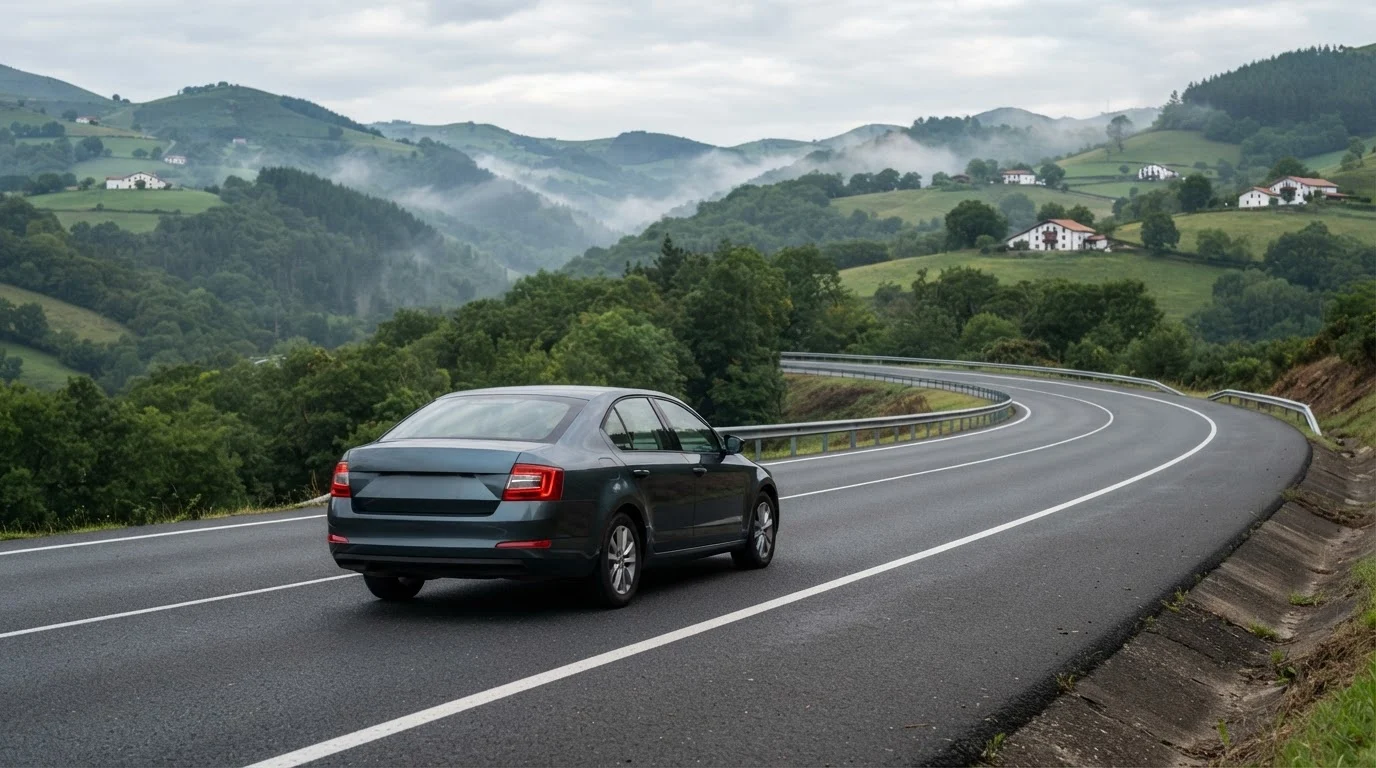
The last part of the drive comes down through the green hills of Gipuzkoa toward the coast. San Sebastián Turismo, the city's official tourism office, describes access by the A-1, AP-8, A-63 and AP-15 roads and notes that the city center is a low-emission zone, where foreign vehicles must be registered in advance. With a driver, you simply give the hotel or apartment address and the rest is arranged around it.
How long is the Barcelona to San Sebastian drive in practice?
The routing figures above assume no traffic and no stops. Real days look different.
Spain's traffic authority, the DGT, advises a break every two hours or every 200 km on long drives. On a journey of more than 500 km, that means at least two or three pauses. Add a lunch stop and the door-to-door time stretches toward eight or nine hours for a relaxed day.
A few things shift the timing:
- Leaving Barcelona: the ring roads and the B-23 can be slow at weekday rush hours, so the departure hour matters.
- Stops: a coffee stop is short; a walk through Pamplona's old town or a visit to Olite takes a couple of hours.
- Arrival: central San Sebastián has narrow streets and busy waterfront roads, and the final kilometers can be slow in summer.
The simplest way to plan is to fix the arrival time you want in San Sebastián and work backward from it, adding the stops you actually want.
Barcelona to San Sebastian by train
What Renfe runs
Renfe's route page for Barcelona to San Sebastián confirms long-distance services from Barcelona Sants to San Sebastián station and lists 07:28 as the first departure from Barcelona Sants. That page does not say whether each itinerary is direct, so check the journey planner for the date you want.
Renfe's open timetable data for high-speed, long-distance and medium-distance trains, published on its open data portal, lists a through Alvia from Barcelona-Sants to San Sebastián-Donostia with no change of train. Its timetabled time is about 6 hours 29 to 6 hours 44 minutes, depending on the calendar. The train calls at Camp de Tarragona, Lleida-Pirineus, Zaragoza Delicias, Tudela de Navarra, Castejón de Ebro, Tafalla, Pamplona/Iruña, Altsasu and Zumarraga on the way.
In the other direction, the same data shows a morning Alvia from San Sebastián-Donostia to Barcelona-Sants timetabled at about 6 hours 16 to 6 hours 34 minutes.
Why the train is not faster
A large part of the line runs on conventional track rather than high-speed line, so the train takes about as long as the car. That is very different from Barcelona to Zaragoza, where the high-speed train is far quicker than the road.
What the train time leaves out
The timetabled time covers only the time between the two stations. A train day also includes getting to Barcelona Sants, passing the security check and finding the platform, carrying bags on and off the train, and getting from San Sebastián station to the final address. If you are planning the Barcelona end, the guide to planning a Barcelona Sants station transfer around your train explains how to time the pickup.
Fares vary by date and train, and Renfe sets them, so this guide does not quote them.
Car with a driver, train or self-drive compared
| What matters | Car with a driver | Train (Renfe Alvia) | Self-drive |
|---|---|---|---|
| Start and finish | The addresses you give at each end | Barcelona-Sants to San Sebastián-Donostia station | Rental pickup to your parking spot |
| Time on the move | About 6 h 15 min to 6 h 35 min without traffic (OpenStreetMap routing) | About 6 h 29 min to 6 h 44 min timetabled (Renfe open timetable data) | Same as the car, plus your own breaks |
| Departure time | Set by you | Set by the timetable | Set by you |
| Stops on the way | Any stop you plan, such as Pamplona or Olite | Only where the train calls | Any stop, but you drive all of it |
| Bags | Loaded at the door | Carried through two stations | Loaded at the rental desk |
| Arrival in the city | Driven to the address | Taxi or local transport from the station | You find parking; the city center is a low-emission zone (San Sebastián Turismo) |
| Onward to Bilbao | Can be added to the same day | A separate trip | You drive it |
| Price | Quoted on request | Set by Renfe | Rental, fuel and road costs |
None of these is the right answer for everyone. The train is a good choice for one or two people with light bags who are happy with a fixed departure. Self-drive suits travelers who want a car for the whole stay in the Basque Country. A car with a driver fits best when the day is about the whole journey, door to door, with stops of your choosing.
Stops between Barcelona and San Sebastian
A drive of more than six hours is easier with one or two real stops. These are general suggestions along or near the corridors described above.
Zaragoza
Zaragoza, the capital of Aragón, sits roughly halfway along the AP-2 corridor. For a long drive, it works as a coffee or lunch stop near the Basílica del Pilar, on the banks of the Ebro. A full guide to Zaragoza as a destination is in the Zaragoza post linked above; here it is simply the halfway point.
Pamplona
Pamplona, the capital of Navarre, sits about an hour from San Sebastián on the A-15. Its walled old town, the Plaza del Castillo and the streets associated with the San Fermín festival make it the most natural lunch stop on the route. If Pamplona itself is the destination, the Barcelona to Pamplona chauffeur page covers that journey.
Olite
Olite, south of Pamplona near Tafalla, is known for its Royal Palace, a Gothic castle with towers and courtyards. It sits close to the AP-15 between Zaragoza and Pamplona, so it fits the AP-2 corridor well. It is a short detour and a good stop for travelers who enjoy history.
The Bardenas Reales
The Bardenas Reales is a semi-desert natural park in southern Navarre, near Tudela, with eroded clay hills and plateaus. It is a striking contrast with the green Basque coast at the end of the day. A visit takes time, so it suits a slower itinerary or an overnight stop rather than a quick break.
How many stops make sense?
For a same-day journey, one lunch stop plus a short coffee break is usually enough. Two significant visits, such as Olite and Pamplona, turn the trip into a long touring day. If you want both, consider an overnight in Pamplona and arrive in San Sebastián the next morning.
When a private driver fits better
A private driver is not always necessary for this route, but it suits several situations clearly.
Luggage
Long trips often mean large suitcases, golf bags or sports gear. With a car and driver, bags are loaded at your Barcelona address and unloaded at your San Sebastián address, with no platforms or station stairs in between.
Families
Children and long train days do not always mix, especially with a change of transport at each end. A car with a driver allows stops when they are needed, not when the timetable allows. Tell the team the ages of any children when you ask for a quote, so the plan can account for them.
Groups
For a group traveling together, one vehicle from door to door keeps everyone and everything in one place. It also removes the need to coordinate several taxis at Barcelona Sants and again at San Sebastián station.
Wanting stops
The train only stops where the timetable says. With a car, a lunch in Pamplona or a visit to Olite is simply part of the route. That turns a long transfer into a day you actually spend seeing northern Spain.
Barcelona to Bilbao and San Sebastian on one trip
Many travelers want both Basque cities. OpenStreetMap routing puts San Sebastián and Bilbao about 100 km apart, a little over an hour by road. A driver can take you to San Sebastián first and on to Bilbao later, or the other way around, as one planned journey. The Barcelona to Bilbao chauffeur page covers the direct route to Bilbao.
Timing that suits you
The through train in Renfe's data leaves Barcelona-Sants in the afternoon and arrives in San Sebastián in the evening. If you want to leave early and arrive for a late lunch, or leave after a morning meeting, a car with a driver is planned around your hours rather than a timetable.
What to send for a quote
Every chauffeur journey is quoted on request. To prepare a quote for Barcelona to San Sebastián, send:
- The route: your pickup address in Barcelona (hotel, apartment, Barcelona Airport or Barcelona Sants) and your destination address in San Sebastián.
- Date and time: the day you want to travel and either the departure time or the arrival time you want.
- Any flight or train: if the journey starts at the airport or a station, give the flight number or train.
- Guests and bags: the number of guests and the number and size of bags.
- Stops: any stops you want on the way, such as Pamplona or Olite, and roughly how long you want at each.
- Onward plans: whether the trip continues to Bilbao, into France or back to Barcelona on another day.
The Barcelona to San Sebastián chauffeur page gives the route at a glance and more about the city at the end of the road.
Planning tips for the journey
- Fix the arrival time first. With more than six hours of driving, work backward from when you want to be in San Sebastián.
- Leave Barcelona outside rush hour. An early start before the morning peak or a mid-morning start after it saves time on the ring roads.
- Choose one main stop. Pamplona is the easiest lunch stop; Olite is the best short history stop; the Bardenas Reales needs more time.
- Think about the return. If you plan to come back to Barcelona by train, check Renfe's journey planner for the morning Alvia from San Sebastián-Donostia.
- Combine the Basque cities. If Bilbao is on the list, plan it as part of the same journey rather than a separate trip.
- Check the train date by date. Timetables change across the year, so confirm the train you want on Renfe's journey planner before you build plans around it.
Conclusion
Barcelona to San Sebastian is a long day either way: about six and a half hours by train on Renfe's through Alvia, or about six to six and a half hours of driving before breaks, according to OpenStreetMap routing. The train works for light travelers happy with a fixed timetable. A car with a driver suits luggage, families, groups, stops in Pamplona or Olite, and onward plans to Bilbao.
To plan the journey, send your route, date and time, any flight or train, and the number of guests and bags through the quote form, on WhatsApp at +34 632 93 79 41, or by email to [email protected].
Questions travelers ask
How far is San Sebastian from Barcelona by road?
OpenStreetMap road routing gives about 512 km on the shortest line through Huesca and Pamplona, and about 570 km on the AP-2 corridor through Lleida, Zaragoza and Pamplona. A longer line through Vitoria-Gasteiz on the AP-68 and AP-1 is about 670 km. The corridor you pick usually depends on where you want to stop.
How long does the Barcelona to San Sebastian drive take?
OpenStreetMap routing estimates about 6 hours 15 minutes to 6 hours 35 minutes of driving without traffic on the two main lines. Spain's DGT advises a pause every two hours or 200 km, so with coffee breaks and lunch a relaxed door to door journey often fills eight hours or more.
Is there a direct train from Barcelona to San Sebastian?
Renfe's open timetable data lists a through Alvia from Barcelona-Sants to San Sebastián-Donostia with no change, timetabled at about 6 hours 29 to 6 hours 44 minutes. It calls at Zaragoza Delicias and Pamplona/Iruña among other stations. Confirm the date you want in Renfe's journey planner, because timetables change during the year.
Is the train faster than driving to San Sebastian?
Not really. Much of the rail line is conventional track rather than high-speed line, so the timetabled train time is close to the driving time. The train adds station transfers at both ends, while a car with a driver goes from your Barcelona address to your San Sebastián address and can stop where you choose.
What are good stops between Barcelona and San Sebastian?
Zaragoza works as a halfway coffee or lunch break on the AP-2. Pamplona, about an hour before San Sebastián, is the easiest lunch stop, with its walled old town. Olite and its Royal Palace sit near the AP-15, and the Bardenas Reales semi-desert near Tudela suits a slower day or an overnight.
Can a private driver continue to Bilbao after San Sebastian?
Yes, an onward leg can be planned as part of the same journey. OpenStreetMap routing puts San Sebastián and Bilbao about 100 km apart, a little over an hour by road. Mention Bilbao when you ask for a quote, with the dates and addresses, so the whole trip is planned and quoted together.
What do I need to send for a Barcelona to San Sebastian quote?
Send the pickup and drop-off addresses, the travel date, your departure or arrival time, any flight or train, and the number of guests and bags. Add any stops such as Pamplona or Olite and any onward plans. Every journey is quoted on request by WhatsApp or phone on +34 632 93 79 41 or by email.
Chauffeur Hire Barcelona
Your own car and driver, quoted on request
Airport, cruise port and station transfers, a driver by the hour, day trips and long-distance journeys from Barcelona, plus 12 private tours priced per group.